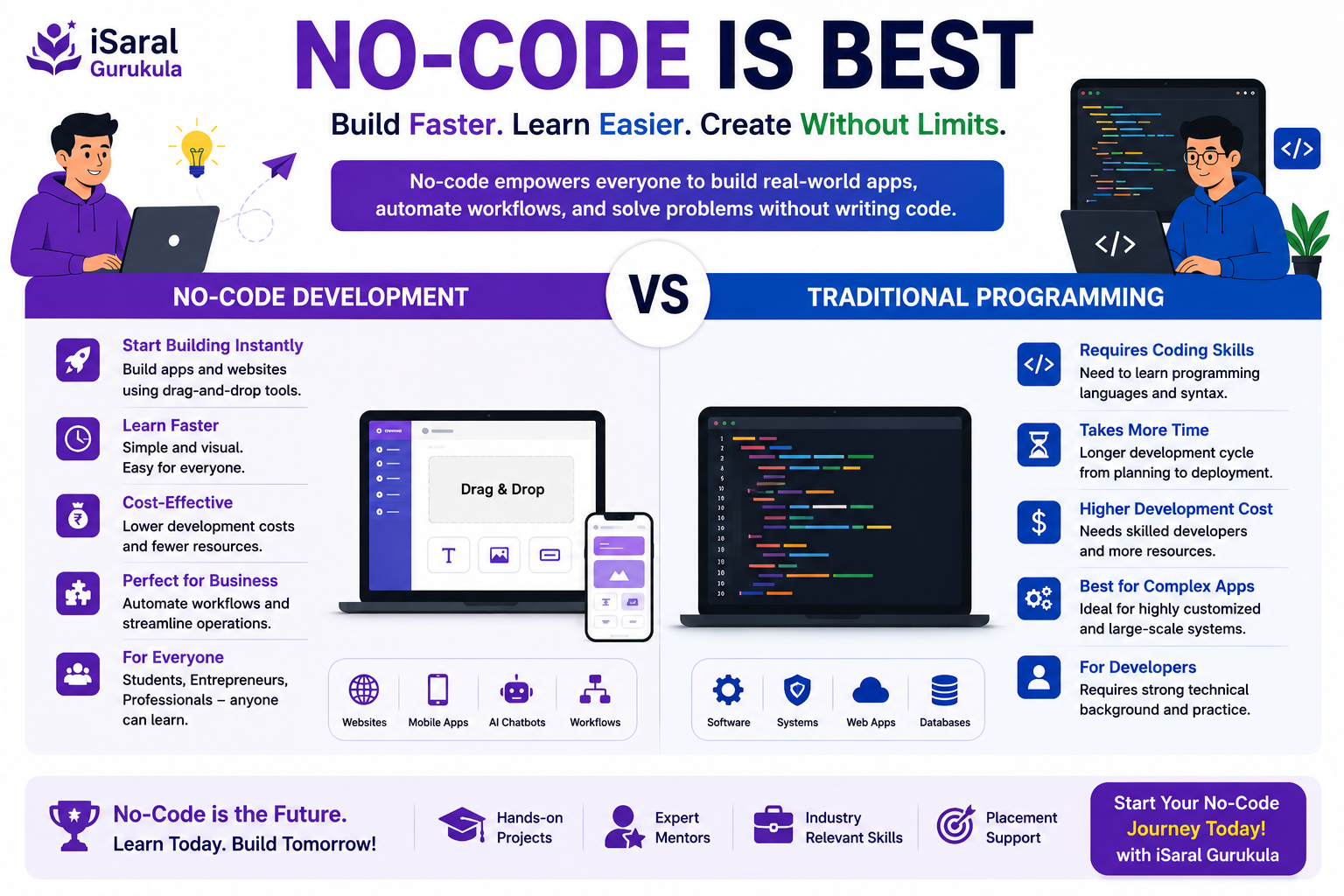
No-Code vs Traditional Programming: Which Path Should You Choose?
The technology industry is evolving rapidly, creating multiple pathways to build a successful career. If you're considering entering tech, you've likely encountered a fundamental question: Should you learn no-code development or traditional programming?
Both approaches have distinct advantages, limitations, and career trajectories. The right choice depends on your goals, learning style, timeline, and the type of problems you want to solve.
This comprehensive guide compares no-code and traditional programming, examining their differences, strengths, weaknesses, and ideal use cases. By the end, you'll have clarity on which path aligns best with your career aspirations.
What Is No-Code Development?
No-code development is a modern approach to building software applications using visual interfaces, drag-and-drop tools, and pre-built components instead of writing traditional code.
- Visual builders and drag-and-drop interfaces
- Pre-built components and templates
- Minimal to zero hand-coded programming
- Focus on workflow logic rather than syntax
- Rapid application development and deployment
- Accessible to non-technical users
Examples of popular no-code platforms include Webflow, Bubble, Make (formerly Zapier), Airtable, FlutterFlow, and many others designed for specific use cases.
What Is Traditional Programming?
Traditional programming (also called "coding") involves writing computer instructions using programming languages like Python, JavaScript, Java, C++, and others. Developers write code that tells computers exactly what to do, line by line.
- Writing code using programming languages
- Complete control over application logic
- Manual debugging and problem-solving
- Requires understanding of algorithms and data structures
- Longer development timeframes
- Steep learning curve for beginners
Traditional programming powers most enterprise applications, operating systems, mobile apps, and complex software systems that run the modern world.
Key Differences Between No-Code and Traditional Programming
| Aspect | No-Code Development | Traditional Programming |
|---|---|---|
| Learning Curve | Beginner-friendly, weeks to months | Steep, 6 months to 2+ years |
| Time to Launch | Days to weeks | Weeks to months or years |
| Cost | Lower platform fees, less labor | Higher labor costs, longer development |
| Customization | Limited to platform capabilities | Complete customization possible |
| Scalability | Good for most use cases | Excellent for complex systems |
| Maintenance | Platform handles updates | Developers maintain and update |
| Flexibility | Constrained by platform tools | Maximum flexibility and control |
| Vendor Lock-In | Dependent on platform viability | Independent, platform agnostic |
Detailed Pros & Cons Comparison
No-Code Development Advantages
- Fast learning and onboarding
- Quick time-to-market
- Lower initial costs
- No coding prerequisites
- Rapid prototyping
- Easier team collaboration
- Limited customization options
- Platform dependency
- Scalability constraints
- Vendor lock-in risk
- Not suitable for complex logic
- Higher recurring costs
Traditional Programming Advantages
- Complete customization
- Unlimited possibilities
- High scalability
- No vendor lock-in
- Strong job market
- Industry standard
- Steep learning curve
- Longer development time
- Higher development costs
- More complex maintenance
- Requires ongoing updates
- Longer time to market
Learning Curve & Speed to Productivity
One of the most significant differences lies in how quickly learners can become productive:
Weeks to Months
Most learners can build working applications within 2-8 weeks of consistent practice with no prior technical experience required.
Months to Years
Most learners require 6-24 months to reach professional proficiency and build production-ready applications independently.
Best Use Cases for Each Approach
When to Choose No-Code
- ✓Rapid Prototyping — Validate business ideas quickly before investing in full development
- ✓MVP Development — Launch Minimum Viable Products fast with limited budget
- ✓Business Automation — Connect tools and automate workflow processes
- ✓Internal Tools — Build dashboards, admin panels, and internal business applications
- ✓Small Businesses — Limited budget and technical resources
- ✓Marketing & Sales Tools — Landing pages, forms, funnels, and lead management
When to Choose Traditional Programming
- →Complex Systems — Requires sophisticated logic, algorithms, and data structures
- →Scalability Critical — Expected to handle millions of users and high transaction volumes
- →Performance Sensitive — Real-time processing, low latency critical
- →Enterprise Applications — Banking, healthcare, government systems requiring strict security
- →Custom Hardware Integration — IoT devices, embedded systems, robotics
- →Specialized Solutions — Machine learning, AI, advanced analytics
Cost Analysis: No-Code vs Traditional Programming
| Cost Factor | No-Code | Traditional Programming |
|---|---|---|
| Initial Training | $0 - $2,000 | $0 - $10,000+ |
| Time to Market | Weeks (low labor cost) | Months (high labor cost) |
| Platform Fees | $0 - $500+/month | None |
| Development Team | 1-2 people | 3-10+ people |
| Maintenance Cost | Low (platform handles) | High (ongoing development) |
| Long-term ROI | Good for startups | Better for enterprises |
Career Opportunities & Market Demand
No-Code Career Path
- 1Growing Demand — Companies increasingly adopt no-code to reduce development costs
- 2Emerging Field — Roles like "No-Code Developer" and "Automation Specialist" are new but growing
- 3Freelance Opportunities — High demand for no-code consultants building solutions for small businesses
- 4Job Market — Currently smaller than traditional programming but expanding rapidly
- 5Salary Range — $50K-$100K+ depending on specialization and location
Traditional Programming Career Path
- 1Massive Demand — Tech industry continues to have critical shortage of skilled developers
- 2Established Career — Well-defined roles, clear progression paths, recognized specializations
- 3Global Opportunity — Remote work, international opportunities, high demand worldwide
- 4Larger Job Market — Hundreds of thousands of jobs available globally
- 5Salary Range — $60K-$250K+ depending on experience, specialization, and location
Making Your Choice: Key Decision Factors
Consider these factors when deciding your learning path:
Timeline
Do you need to earn money quickly (no-code) or invest time in deeper skills (traditional)?
Budget
Can you afford 6-12 months of learning (traditional) or do you need faster ROI (no-code)?
Goals
Build products and startups (no-code) or work for tech companies (traditional)?
Learning Style
Visual/intuitive learner (no-code) or logical/analytical thinker (traditional)?
Problem Type
Business automation & quick solutions (no-code) or complex systems (traditional)?
Career Vision
Entrepreneurship/consulting (no-code) or enterprise development (traditional)?
Why You Don't Have to Choose: Learn Both
Here's an important insight: These aren't mutually exclusive paths. The most successful technologists often understand both approaches.
Start with No-Code
Begin with no-code to quickly build products, gain confidence, and understand business logic. Then transition to programming for deeper technical skills.
Start with Programming
Learn traditional programming fundamentals, then use no-code tools to accelerate development. This gives you both options.
Find Your Perfect Tech Career Path
At iSaral Gurukula, we help you discover whether no-code, traditional programming, or a combination of both aligns best with your goals.
Career Assessment
Personalized evaluation of your skills, goals, and preferences
Customized Roadmap
Learn the right skills in the right order for your specific goals
Expert Mentorship
Guidance from industry professionals with real-world experience
Job Placement Support
Help landing your first role or scaling your freelance career
Frequently Asked Questions
Is no-code a replacement for traditional programming?
No. No-code complements traditional programming but doesn't replace it. Each has specific use cases, and many organizations use both approaches.
Which path leads to higher salaries?
Traditional programming generally offers higher salary potential, but no-code specialists can earn well through freelancing and consulting, especially as the field matures.
Can I learn both no-code and programming?
Absolutely. Many professionals learn both. Starting with no-code can build confidence, then transitioning to programming is a popular approach.
Which is easier to learn?
No-code is significantly easier to learn for most people. Most can build functional apps within weeks, while programming requires months of dedicated study.
Will no-code skills become obsolete?
Unlikely. As more organizations adopt no-code for rapid development, the demand will likely continue growing. However, traditional programming won't disappear.
Which should a beginner learn first?
If you want quick wins and fast entry into tech, start with no-code. If you want deeper technical knowledge and maximum flexibility, start with programming. Many experts recommend starting with no-code, then adding programming.
Conclusion
The no-code vs traditional programming debate isn't about one being "better" — it's about recognizing that they solve different problems and serve different purposes.
No-code is best for: Rapid prototyping, business automation, quick MVP development, and professionals wanting fast entry into tech without deep programming knowledge.
Traditional programming is best for: Complex systems, enterprise applications, maximum customization, scalability, and careers requiring deep technical expertise.
The smartest approach is to understand your specific goals, timeline, and the type of problems you want to solve. Consider starting with no-code for confidence and quick results, then adding traditional programming skills for deeper capabilities and greater career flexibility.
At iSaral Gurukula, we help you chart the right path for your unique goals. Whether you choose no-code, traditional programming, or both, we provide the training, mentorship, and support to help you succeed in your tech career journey.