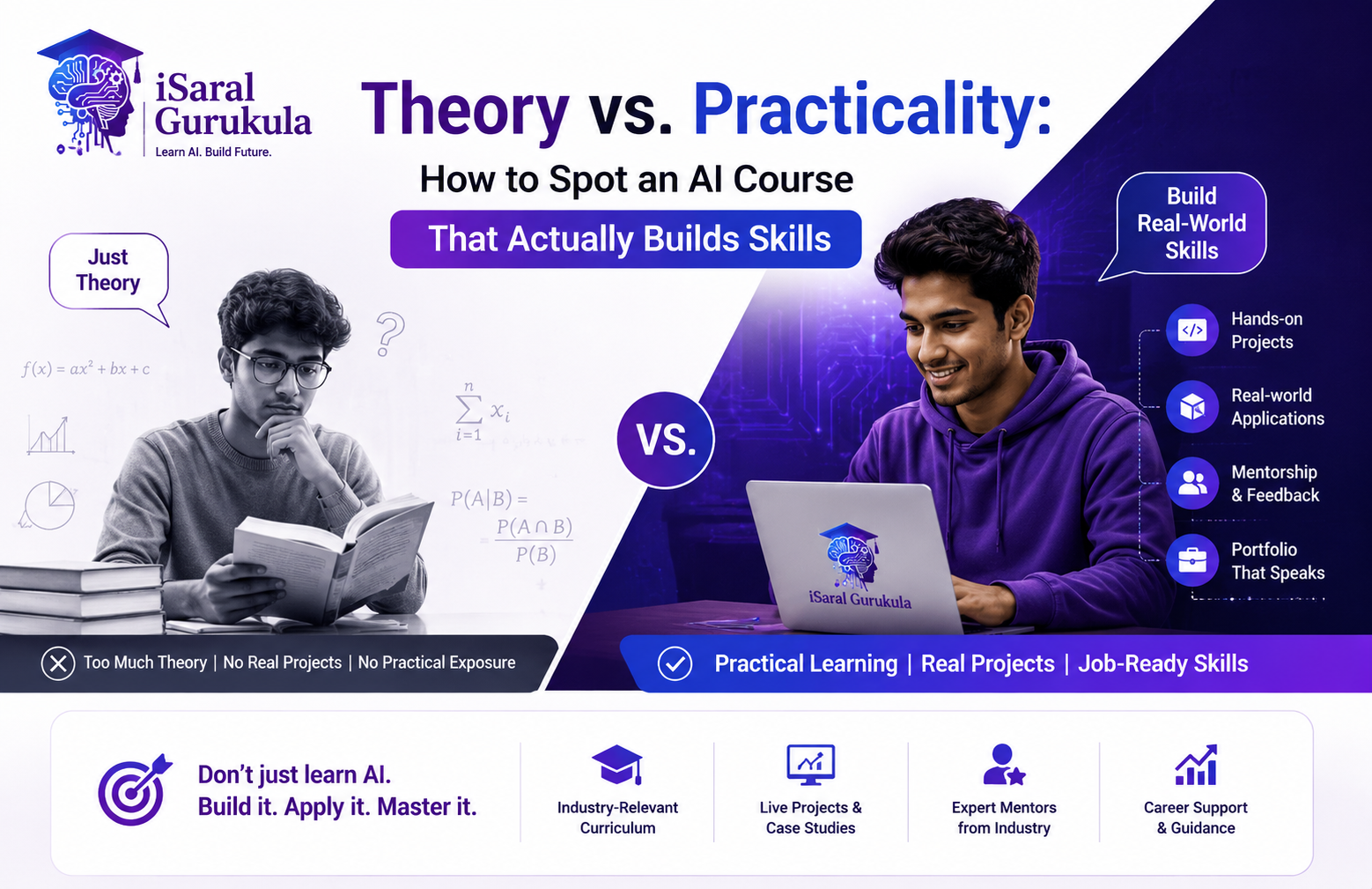
You've probably seen the ads. A polished course promising to make you "AI-ready" in 30 days, complete with impressive-sounding modules and a certificate at the end. But once you're inside, it's mostly slides, definitions, and concepts you'll never actually touch. Sound familiar?
This guide is built for people trying to break into AI, upskill for a new role, or build real projects you can show employers—not for researchers writing papers, and not for people who just want a credential to frame. For people who want to actually do something with what they learn.
- How to tell the difference between theory-driven and hands-on practical courses
- The red flags and green flags that signal quality before you spend a dollar
- How practical AI skills actually open career doors—and why theory alone rarely does
- The exact questions to ask course creators before enrolling
- How to build visible proof that gets you interviews
The Growing Problem With Theory-Heavy AI Courses
Why Most AI Courses Overwhelm Learners With Concepts But Skip Application
When you jump into an AI course, you often get buried under layers of dense math, abstract theories, and lengthy lectures about how algorithms work in principle—but nobody shows you how to actually use them. Most course creators design around what sounds impressive rather than what gets you building things. You end up memorizing definitions instead of writing code, running models, or solving a real dataset problem. The curriculum feels complete on paper, but your hands never touch anything that matters.
The Hidden Cost of Finishing a Course Without Job-Ready Skills
Completing a course feels like a win—until you sit across from a hiring manager and blank out when they ask you to walk through a real project. Your certificate looks great, but your portfolio is empty, your GitHub has nothing to show, and your confidence drops fast. That gap between course completion and actual readiness costs you time, money, and opportunities you could have grabbed earlier.
How to Recognize When You Are Learning to Pass Quizzes Rather Than Solve Problems
Watch for these patterns in your learning experience:
- Your progress is measured by quiz scores, not by whether your model actually runs
- You never debug anything—every exercise works perfectly on the first try
- The assignments have one correct answer with no room for your own approach
- You can explain a concept but freeze when someone asks you to demo it
- No messy, real-world data ever shows up in your practice sets
If your biggest challenge in a course is remembering terminology rather than figuring out why your code broke, you are training yourself to test well, not to think well.
Key Markers of a Practically Focused AI Course
A. Real-World Projects That Mirror Actual Industry Challenges
When you're evaluating an AI course, look at whether the projects feel like something a real company would actually pay someone to solve. Your portfolio should include work like:
Building a Recommendation Engine
Similar to what Netflix or Spotify runs—not a toy dataset, but something that teaches real system design
Training on Messy Real-World Data
Not clean, pre-packaged datasets. Learn to handle missing values, outliers, and the chaos of actual data
Solving Business Problems Holistically
Where the goal isn't just accuracy, but cost, speed, and scalability matter too
B. Hands-On Tools and Platforms Used by Working Professionals
If a course doesn't get your hands dirty with tools professionals use daily, you're learning in a vacuum. Watch for courses that walk you through:
Python Libraries
Pandas, Scikit-learn, PyTorch—the tools that actually power production AI systems
Cloud Platforms
AWS SageMaker, Google Vertex AI, Azure ML—where real models get deployed
Version Control & Collaboration
Git and GitHub—how teams actually ship code and collaborate
C. Assignments That Require Building and Deploying, Not Just Reading
Reading about neural networks is very different from actually shipping one. Your assignments should push you to build something end-to-end—from raw data all the way to a working, deployed model that someone else can interact with.
D. Assessments Based on Outcomes Rather Than Memorization
Your performance should be judged on what you can produce, not what you can recite. Strong courses grade you on whether your model works, how well it performs, and how clearly you can explain your decisions—not whether you memorized a definition.
Red Flags That Signal a Theory-Driven Course
A. Slides and Lectures With No Coding or Experimentation
If your course is just one slide deck after another with zero hands-on work, that's your first warning sign. Real AI skills don't come from watching someone else explain neural networks—they come from you actually building, breaking, and fixing things yourself.
- Every lesson ends with a quiz instead of a mini project
- You're never asked to open a Jupyter notebook, write a script, or run a model
- Passive learning feels productive but leaves you empty-handed when a real challenge shows up
B. Outdated Examples Disconnected From Current AI Applications
When a course still references examples from five or six years ago without connecting them to what's happening right now in the field, that's a red flag you shouldn't ignore. AI moves fast, and your learning material should keep up.
- Old case studies about basic image classifiers won't prepare you for working with large language models or diffusion systems
- You need examples that reflect tools and workflows people are actually using on the job today
- If the instructor never mentions recent developments, your skills will already be stale before you finish
C. No Feedback Loops or Mentor Guidance on Your Work
You can't grow without knowing where you went wrong. A course that drops content on you and disappears offers no real learning experience—just information consumption.
Without someone reviewing your code or your project approach, you'll repeat the same mistakes without knowing it. Look for structured feedback from mentors, peers, or automated systems that actually evaluate your output.
D. Certificates Awarded Without Demonstrated Practical Output
If a course hands you a certificate just for sitting through videos or passing multiple-choice tests, that certificate means very little to anyone hiring in AI right now.
- Employers want to see what you've actually built, not just a PDF that says you completed a course
- Meaningful credentials should be tied to projects, capstone assignments, or real-world problem-solving tasks you completed yourself
- Ask yourself: Did you have to produce anything to earn that certificate, or did you just need to show up?
E. Course Content That Never Evolves With the Fast-Moving AI Landscape
AI is one of the fastest-moving fields out there, and a course frozen in time simply can't serve you well. If the content hasn't been touched in two years, you should think twice before enrolling.
- When was the course last updated? Recent updates signal active curation
- Were new modules added recently? Shows the creator is keeping pace with the field
- A course that doesn't grow as the field grows will leave you learning yesterday's solutions for today's problems
- The best courses treat their curriculum as a living document, not a finished product collecting dust
Questions to Ask Before Enrolling in Any AI Course
What Will You Be Able to Build by the End of the Course?
Before you hand over your money or time, ask this one question: What will I actually create? A solid AI course should give you a clear, specific answer—not vague promises about "understanding AI concepts." You want to walk away with real projects in your portfolio, like a working chatbot, a trained model, or a deployed application.
- Look for courses that list specific deliverables, not just topics covered
- Check if past students have shared their projects publicly—GitHub repos, demos, or case studies are great signs
- If the course page only talks about what you'll learn rather than what you'll build, that's a warning sign worth paying attention to
Who Designed the Curriculum and What Is Their Industry Background?
The person who built the course shapes everything about it. If your instructor spent the last decade writing academic papers but never shipped a product, the course will likely reflect that gap. You want someone who has actually solved real problems with AI—someone who knows what breaks in production and why.
- Search the instructor's LinkedIn and look for roles at tech companies, startups, or consulting firms
- Check if they've built tools, contributed to open-source AI projects, or worked with real datasets outside of classroom settings
- Academic credentials matter, but industry experience matters more when your goal is practical skill-building
How Much of the Course Time Is Dedicated to Hands-On Practice?
Time allocation tells you everything. If 80% of the course is video lectures and 20% is coding, you're essentially paying for a textbook with a play button. Flip that ratio and you're looking at something worth your investment.
- Ask for a breakdown of the curriculum by type—lectures vs. labs vs. projects
- Look for courses that include coding exercises after every major concept, not just at the end
- Platforms that offer sandboxed environments or built-in notebooks usually signal a stronger commitment to hands-on learning
How Practical AI Skills Translate Into Career Opportunities
Employers Value Demonstrated Ability Over Credential Names
Hiring managers aren't impressed by course names on your resume—they want to see what you can actually do. When you walk into an interview with real projects, working models, and hands-on experience, you stand out immediately from candidates who only completed theory-heavy programs.
Portfolio Projects That Prove Your Capability to Hiring Managers
Your portfolio is your proof. When you build real AI projects during your training—whether that's a recommendation engine, a sentiment analysis tool, or a computer vision app—you give hiring managers something tangible to evaluate. These projects show your problem-solving process, your technical choices, and your ability to deliver results, which no certificate alone can communicate.
- Build projects that solve real-world problems, not just textbook exercises
- Document your thought process so reviewers understand your decisions
- Share your work on GitHub or similar platforms where employers actively search for talent
Practical Skills That Help You Contribute From Day One on the Job
When your training involved real tools, real data, and real deployment challenges, you don't need a slow ramp-up period at your new job. You already know how to clean messy datasets, debug model errors, and ship something that actually works. That kind of readiness makes you genuinely valuable from your very first week, and employers notice—and reward—that immediately.
The Final Takeaway: Choose Courses That Build Real Skills
Choosing the right AI course can feel overwhelming, but the difference between one that actually builds skills and one that just sounds impressive comes down to how much real, hands-on work is involved. A course worth your time will get you building, testing, and problem-solving from day one—not just reading slides or memorizing definitions.
Spotting red flags early, asking the right questions before you enroll, and knowing what practical skill-building looks like will save you from wasting months on content that won't move the needle in your career.
The AI job market rewards people who can do things, not just talk about them. So when you're evaluating your next course, hold it to a high standard. Look for projects you can add to a portfolio, instructors who work in the field, and a curriculum that mirrors real-world challenges. Your time and money deserve a course that takes you somewhere—and now you have exactly what you need to find one that does.
Practical AI Learning Checklist
Your complete checklist for evaluating any AI course before enrollment. Includes the exact red flags to watch for, questions to ask creators, and a step-by-step guide to building a portfolio that gets interviews.
Course Evaluation Checklist
20 questions that reveal if a course is actually practical
Red Flags & Green Flags
The warning signs and positive indicators before you commit
Portfolio Building Framework
How to turn course projects into interview-winning proof
Instructor Vetting Guide
How to verify if your instructor actually has industry experience