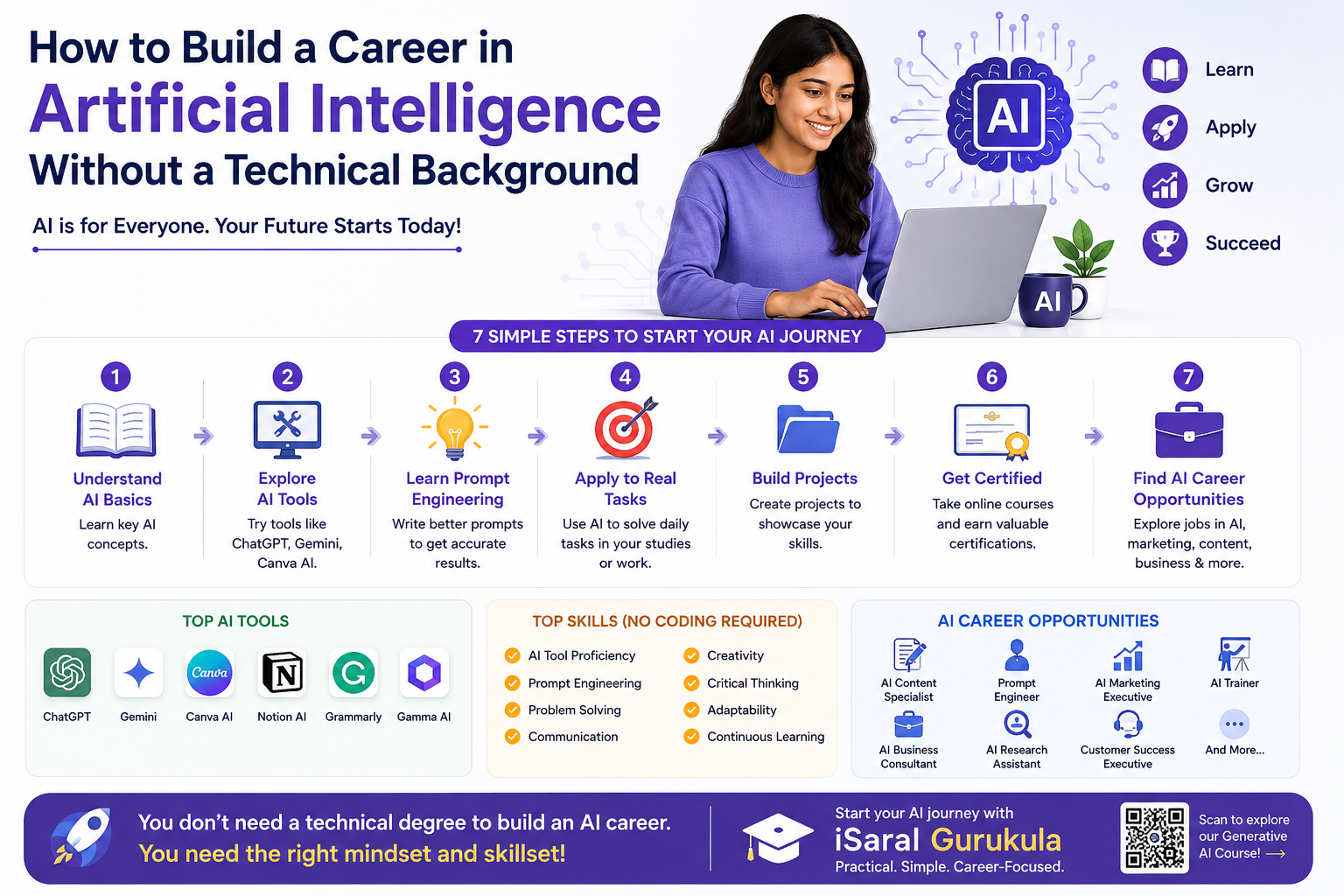
How to Build a Career in Artificial Intelligence Without a Technical Background
Artificial Intelligence (AI) is no longer limited to software engineers and data scientists. Today, professionals from marketing, finance, HR, education, healthcare, sales, business, and even creative fields are using AI to improve productivity and solve real-world problems.
If you think you need a computer science degree or programming expertise to start a career in AI, think again. Modern AI tools have made it easier than ever for anyone to learn, apply, and benefit from AI.
Whether you're a student, a graduate, a working professional, or someone looking to switch careers, you can build a successful future in AI — even without a technical background. In this blog, we'll explore practical steps to start your AI journey, the skills you need, career opportunities, and how you can become job-ready with the right learning approach.
Why AI Is Creating Opportunities for Everyone
Artificial Intelligence is transforming industries across the globe. Businesses are adopting AI to automate repetitive tasks, improve customer service, analyze data, create content, and make better decisions. As AI adoption grows, companies need professionals who can understand business problems and use AI tools effectively — not just build AI models from scratch.
- Marketing professionals using AI for content creation
- HR teams using AI for recruitment
- Teachers using AI to prepare lesson plans
- Sales teams using AI for lead generation
- Business owners automating customer support
- Designers creating visuals with AI tools
- Writers improving productivity using AI assistants
Do You Need Coding Skills to Learn AI?
The simple answer is No. While programming can be useful for advanced AI development, many AI-related careers today focus on using AI tools rather than building them.
Generative AI platforms like ChatGPT, Gemini, Microsoft Copilot, Canva AI, and Notion AI allow users to perform complex tasks through natural language prompts. Learning how to use these tools effectively is becoming a valuable professional skill.
Who Can Build a Career in AI?
AI is suitable for people from almost every educational background.
- BCA student
- B.Com graduate
- B.Sc student
- BA graduate
- MBA student
- Teacher, Accountant
- Marketing professional
- HR executive, Entrepreneur
- Sales professional
- Content creator, Freelancer, Job seeker
No matter your background, AI can become a valuable addition to your skill set.
8 Steps to Build a Career in AI
Before using AI tools, it's important to understand what Artificial Intelligence actually is. Learn concepts like Artificial Intelligence, Machine Learning, Generative AI, Large Language Models (LLMs), Natural Language Processing (NLP), Automation, and Prompt Engineering.
You don't need to study complex mathematics or algorithms at this stage — focus on understanding how AI works and where it can be applied.
Instead of spending months learning programming, begin with practical AI tools widely used in businesses: ChatGPT, Google Gemini, Microsoft Copilot, Canva AI, Notion AI, Grammarly AI, Gamma AI, and Perplexity AI.
- Writing emails and summarizing documents
- Creating presentations and generating ideas
- Research and content creation
- Resume building and business planning
Prompt engineering is the skill of communicating effectively with AI tools. Instead of asking vague questions, you learn how to write detailed instructions that produce high-quality results.
Instead of "Write a blog," try: "Write a 1,200-word SEO-friendly blog for beginners explaining the benefits of AI in education with headings, examples, and a conclusion."
The best way to learn AI is by solving practical problems relevant to your own role — students preparing study plans, marketers writing campaign content, HR teams drafting job descriptions, and business owners automating customer support.
Employers value practical skills more than theory. Create simple projects like an AI-powered resume builder, content generator, marketing campaign planner, customer support chatbot, or study assistant.
Responsible AI usage is becoming increasingly important. Understand data privacy, copyright considerations, fact-checking AI responses, avoiding plagiarism, and human oversight.
A strong portfolio helps showcase your AI skills — include AI-generated presentations, blog articles, prompt engineering examples, automation workflows, and case studies. Even as a beginner, a well-organized portfolio can make a strong impression.
AI certifications demonstrate your commitment to learning. Look for programs covering Generative AI, Prompt Engineering, AI Productivity Tools, AI Automation, real-world projects, and career guidance.
Career Opportunities in AI for Non-Technical Professionals
Learning AI opens the door to many exciting roles — most of which focus on applying AI rather than developing algorithms.
AI Content Specialist
Create and optimize AI-assisted content across formats
Prompt Engineer
Design effective prompts for consistent, high-quality output
AI Trainer
Teach teams and individuals how to use AI tools effectively
AI Marketing Executive
Apply AI across campaigns, content, and customer engagement
AI Research Assistant
Support research and analysis using AI-powered tools
Customer Success Executive
Support customers using AI products and platforms
AI Business Consultant
Advise businesses on adopting AI into their workflows
AI Operations Associate
Manage day-to-day AI-powered business operations
AI Productivity Specialist
Help teams work faster using AI tools and automation
Skills That Employers Look For
Employers increasingly value candidates who can combine AI tools with business knowledge.
- ✓AI Tool Proficiency: Comfortable using leading AI platforms daily
- ✓Prompt Engineering: Able to write instructions that produce quality output
- ✓Communication & Critical Thinking: Evaluate and refine AI-generated work
- ✓Problem-Solving & Creativity: Apply AI to real business challenges
- ✓Research, Collaboration & Adaptability: Stay current as AI tools evolve
Common Myths About AI Careers
| Myth | Reality |
|---|---|
| Only engineers can learn AI | AI is being used by professionals from almost every field |
| AI will replace all jobs | AI is changing how people work — those who know how to use it well have more opportunities |
| You need advanced mathematics | For many AI-related roles focused on using AI tools, advanced mathematics isn't required |
| Learning AI takes years | You can begin using AI tools productively within weeks through consistent practice |
Tips for Success
Practice Every Day
Practice with AI tools daily, stay updated with new trends, and work on practical projects consistently.
Learn With Others
Build a portfolio, network with professionals, and participate in webinars and workshops to keep learning as AI evolves.
Why Learn AI with iSaral Gurukula?
At iSaral Gurukula, we believe AI education should be practical, accessible, and career-focused. Our Generative AI program is designed for students, graduates, and working professionals from both technical and non-technical backgrounds.
- ✓Introduction to AI & Generative AI — Build a solid foundation from scratch
- ✓Hands-On Practice — Work with leading AI tools directly
- ✓Prompt Engineering Techniques — Learn to get consistently better AI output
- ✓Real-World Projects — Apply your learning to genuine assignments
- ✓Career Guidance — Portfolio development and job readiness support
- ✓Industry-Relevant Use Cases — Across different professions and sectors
Build Your AI Career, No Coding Needed
Join thousands of students learning Generative AI with hands-on projects, expert mentorship, and career support.
No Coding Required
Learn AI using no-code platforms accessible to everyone
Hands-On Projects
Build real AI applications and create a portfolio
Expert Mentorship
Learn from professionals with real AI experience
Career Support
Job preparation, interviews, and placement assistance
Conclusion
Building a career in Artificial Intelligence no longer requires a technical degree or years of programming experience. With the rise of Generative AI and easy-to-use AI tools, anyone with curiosity, dedication, and a willingness to learn can develop valuable AI skills.
Start by understanding the basics, explore popular AI tools, practice prompt engineering, work on real-world projects, and build a portfolio that showcases your abilities. As businesses continue to embrace AI, professionals who can use these technologies effectively will be well-positioned for future opportunities.
The best time to start learning AI is now. With consistent practice and the right guidance, you can build a rewarding career in Artificial Intelligence — regardless of your educational background.
Frequently Asked Questions
Do I need a computer science degree to work in AI?
No. Many AI-related roles focus on using AI tools effectively rather than building AI models, so a technical degree is not a requirement for most non-technical AI careers.
How long does it take to become job-ready in AI?
With consistent practice, many learners begin using AI tools productively within weeks, though building a strong portfolio and job-ready skills typically takes a few months of focused effort.
Which AI tools should beginners learn first?
Start with widely used platforms like ChatGPT, Google Gemini, and Microsoft Copilot, then explore specialized tools like Canva AI or Notion AI based on your profession.
Is prompt engineering a real career skill?
Yes. The ability to write clear, detailed instructions that get consistent, high-quality results from AI tools is increasingly valued across marketing, content, research, and operations roles.
Can working professionals switch careers into AI?
Yes. Professionals from marketing, HR, finance, education, and other fields regularly transition into AI-focused roles by combining their existing domain expertise with AI tool proficiency.
What should go into an AI portfolio for beginners?
Include AI-generated presentations, blog articles, prompt engineering examples, small automation projects, and case studies that demonstrate practical, real-world application of AI tools.
Explore More Resources
Career Benefits of Learning Generative AI
Discover job opportunities, salary potential, and career growth from learning AI skills.
🚀 BeginnerComplete Beginners Guide to Learning AI
Step-by-step guide to start your AI journey without any coding experience.
📚 AI CourseGenerative AI Course for Students
Generative AI Course for students looking to build a career in AI.