What Is Prompt Engineering and Why Is It Important?
Artificial Intelligence (AI) is becoming an important part of education, business, software development, marketing, customer service, and many other industries. Tools powered by Generative AI can create text, analyze information, generate ideas, write code, and assist with everyday tasks.
However, the quality of an AI response often depends on how you communicate with the AI. This is where prompt engineering becomes important.
In this guide, we will understand what prompt engineering is, why it matters, how it works, and how beginners can develop this valuable AI skill.
What Is Prompt Engineering?
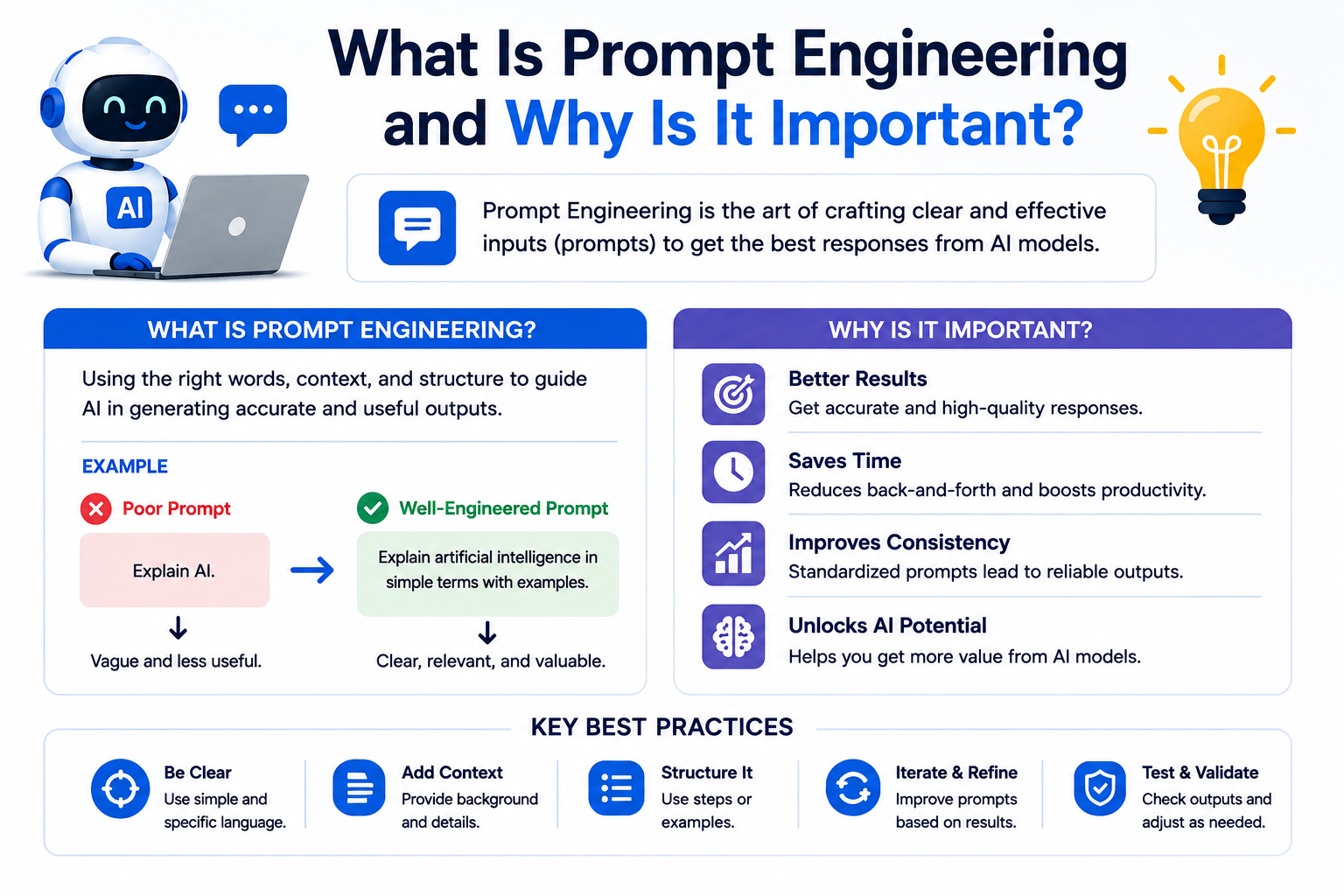
Prompt engineering is the process of creating clear and effective instructions (prompts) to get useful and relevant results from AI models. A prompt is simply the input or instruction you give to an AI tool.
For example, instead of asking:
You could provide a more specific prompt:
The second prompt gives the AI more context and direction, which can help produce a more useful response.
Why Is Prompt Engineering Important?
As AI tools become more widely used, knowing how to communicate effectively with them can improve productivity and the quality of results.
Clear instructions help AI understand what you actually need. A well-structured prompt can specify:
- The topic
- The goal
- The target audience
- The desired format
- The tone
- Important information to include
This can make the response more relevant and useful.
Instead of repeatedly asking an AI tool to change or improve an answer, a detailed prompt can provide the required instructions from the beginning — for example: "Create a professional LinkedIn post for software developers, keep it under 150 words, and use a professional but friendly tone."
Prompt engineering can help professionals use AI for many everyday tasks, including:
- Writing emails
- Creating content
- Summarizing documents
- Generating ideas
- Writing code
- Creating marketing content
- Analyzing information
- Creating reports and presentations
Prompt engineering isn't limited to AI engineers. It can be useful for:
- Software developers
- Digital marketers
- Content writers
- Business professionals
- Teachers and students
- Entrepreneurs
- Data analysts
- Customer support teams
Basic Elements of a Good Prompt
A strong prompt usually contains several important elements.
- 1Role — Tell the AI what role it should take. Example: "Act as an experienced digital marketing specialist."
- 2Task — Clearly explain what you want the AI to do. Example: "Create a content strategy for a technology training website."
- 3Context — Provide relevant background information. Example: "The target audience is college students and fresh graduates looking to build technology careers."
- 4Format — Tell the AI how you want the answer presented. Example: "Present the strategy as a table with topic, target keyword, content type, and objective."
- 5Constraints — Mention any limitations or requirements. Example: "Keep each topic under 15 words and use simple English."
Simple Prompt vs Effective Prompt
"Write a blog about AI."
This doesn't give the AI enough information about your requirements.
"Act as an experienced technology content writer. Write a 1,000-word beginner-friendly blog about Artificial Intelligence. Explain what AI is, its benefits, common applications, and career opportunities. Use simple English, include headings and bullet points, and target college students and fresh graduates."
The second prompt provides role, task, context, audience, format, and requirements.
Common Prompt Engineering Techniques
-
1Zero-Shot Prompting
You ask the AI to complete a task without providing examples — e.g. "Translate this paragraph into simple English."
-
2Few-Shot Prompting
You provide examples to show the AI what kind of response you expect, such as two sample product descriptions before asking for another in the same style.
-
3Role Prompting
You assign a specific role to the AI — e.g. "Act as a Python programming instructor and explain Python functions to a beginner."
-
4Step-by-Step Instructions
Breaking a complex task into smaller steps — e.g. "First identify the target audience. Then suggest five content ideas. Finally, create a content calendar."
-
5Iterative Prompting
You don't need the perfect prompt in one attempt — start with a prompt, review the response, then refine: "Make the explanation simpler," then "Add three real-world examples."
Where Is Prompt Engineering Used?
Prompt engineering can be applied across many industries.
Education
Generate study materials, explain difficult concepts, create quizzes, and summarize topics.
Software Development
Generate code examples, explain concepts, debug code, and create documentation.
Marketing
Generate content ideas, social posts, campaign concepts, and analyze feedback.
Business
Assist with reports, customer communication, data analysis, and process documentation.
Data Analysis
Summarize datasets, generate insights, and explain findings in plain language.
Customer Support
Draft responses, summarize tickets, and speed up resolution times.
How to Learn Prompt Engineering
You don't need to be an expert programmer to start learning prompt engineering.
- ✓Step 1: Understand Generative AI — Learn how AI tools such as large language models work at a basic level.
- ✓Step 2: Practice Writing Clear Instructions — Experiment with different prompts and observe how changing your instructions changes the output.
- ✓Step 3: Learn Prompting Techniques — Explore role prompting, few-shot prompting, structured prompts, and iterative prompting.
- ✓Step 4: Practice With Real Tasks — Use AI for tasks you actually perform, such as writing emails, creating content, or learning programming.
- ✓Step 5: Evaluate AI Responses — Always review AI-generated information; human judgment remains important.
Is Prompt Engineering a Good Career Skill?
Prompt engineering can be a valuable AI-related skill, especially when combined with another professional skill such as programming, marketing, data analysis, education, or business.
Rather than treating prompt engineering as an isolated skill, professionals can combine it with their existing expertise to create more effective AI-assisted workflows.
Python + AI + Prompt Engineering
Can help a developer build AI-powered applications faster and more effectively.
Digital Marketing + AI + Prompt Engineering
Can help marketers create and optimize content more efficiently.
Learn Prompt Engineering at iSaral Gurukula
At iSaral Gurukula, we help students, professionals, and entrepreneurs master prompt engineering and applied AI skills through practical, project-based training.
- 1Introduction to Generative AI
- 2Prompt Structure and Core Elements
- 3Zero-Shot and Few-Shot Prompting
- 4Role and Persona Prompting
- 5Step-by-Step and Iterative Prompting
- 6Prompting for Content, Code, and Data
- 7AI Tools for Business Workflows
- 8Real-World Projects
- 9Career Guidance
- 10Portfolio Development
Whether your goal is to work more effectively with AI tools, build AI-powered projects, or pursue a career in technology, our hands-on training prepares you with industry-relevant skills.
Frequently Asked Questions (FAQs)
What is prompt engineering?
Prompt engineering is the process of creating clear and effective instructions to get useful, relevant results from AI models.
Do I need programming skills to learn prompt engineering?
No. Prompt engineering focuses on clear communication with AI tools and does not require programming knowledge to get started.
Which careers benefit from prompt engineering?
Software developers, marketers, content writers, business professionals, teachers, students, entrepreneurs, data analysts, and customer support teams can all benefit.
What are some common prompting techniques?
Common techniques include zero-shot prompting, few-shot prompting, role prompting, step-by-step instructions, and iterative prompting.
Is prompt engineering a good career skill?
Yes, especially when combined with another professional skill such as programming, marketing, data analysis, education, or business.
Ready to Get Better Results from AI?
Join iSaral Gurukula's Prompt Engineering Program and learn how to write effective prompts for content, code, data, and everyday business tasks through hands-on, project-based training.
Practical Training
Project-based learning designed for real outcomes
Build a Portfolio
Practice real prompts across content, code, and data while you learn
Beginner to Advanced
No programming background required to get started
Career Guidance
Prepare for freelance, startup, or full-time opportunities
Conclusion
Prompt engineering is an important skill in the growing world of Generative AI. It focuses on creating clear, specific, and structured instructions that help AI tools produce more useful results.
Whether you are a student, developer, marketer, entrepreneur, or working professional, learning how to use AI effectively can improve productivity and open new opportunities.
The best way to learn prompt engineering is through practice. Start with simple prompts, experiment with different instructions, evaluate the results, and gradually learn more advanced techniques. Start learning AI today and make prompt engineering part of your future-ready skill set.