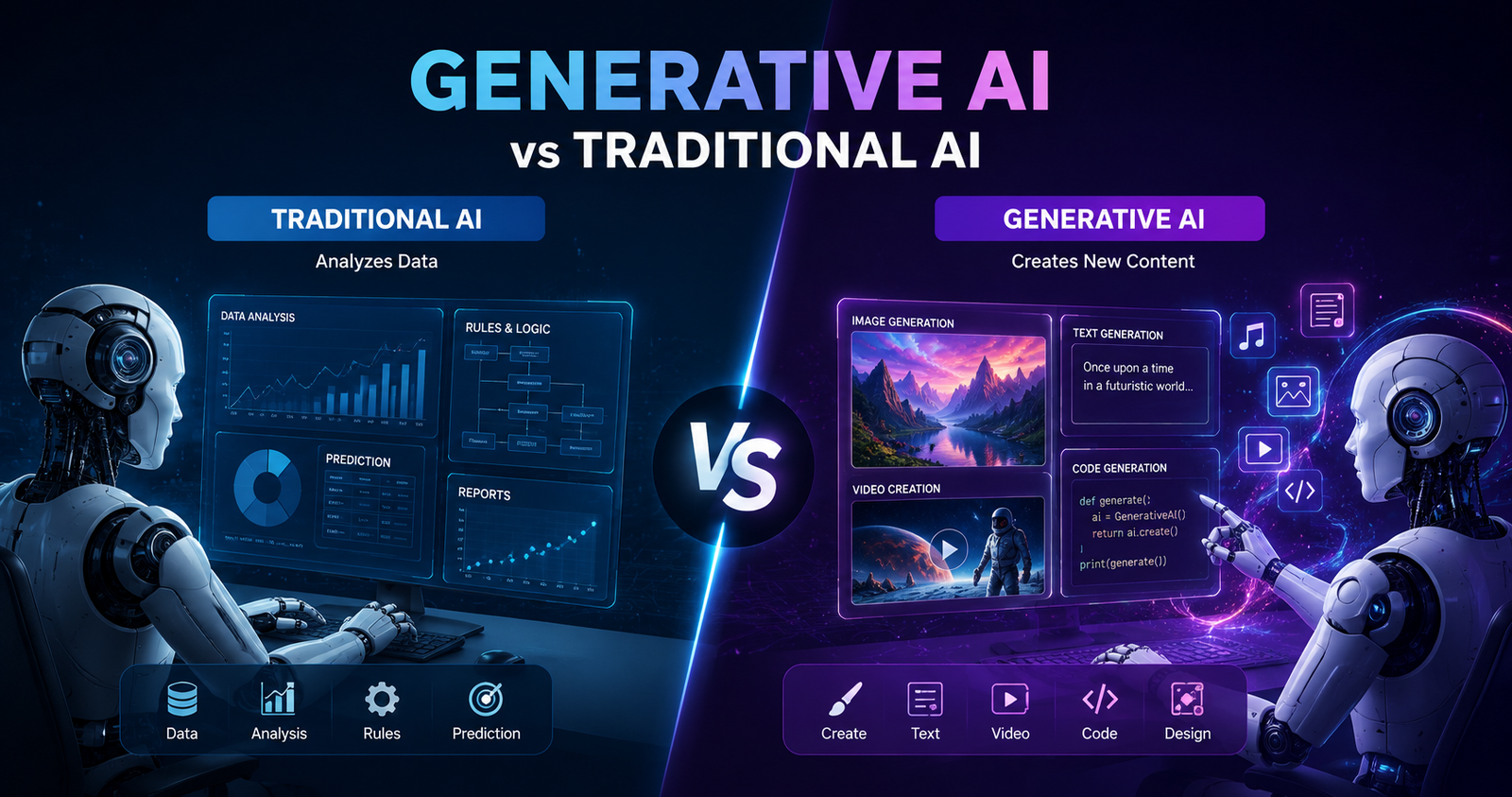
There is a good chance you have used artificial intelligence today without realising it. The app that predicted your next word while typing a message. The bank notification that flagged an unusual transaction before you noticed it. The music platform that lined up three songs in a row that matched your exact mood. All of that is artificial intelligence at work — and none of it is what people mean when they talk about Generative AI.
The term "Artificial Intelligence" has become one of the most overused and misunderstood phrases in technology. When professionals say they want to "learn AI" or businesses say they are "implementing AI," they are often talking about two completely different things without realising it. Understanding the distinction between Traditional AI and Generative AI is not a technical exercise — it is the foundation for making smarter decisions about your career, your business, and how you spend your learning time.
This article breaks down exactly what separates these two branches of AI, where each one is genuinely useful, and why the difference matters far more in 2026 than it did even two years ago.
1. What Traditional AI Actually Does
Traditional AI has been quietly running the world for over two decades. Every time a bank approves or rejects a loan application in seconds, every time an e-commerce platform shows you a product you were genuinely considering buying, every time a factory sensor detects equipment failure before it happens — that is Traditional AI doing its job.
At its core, Traditional AI is built to analyse existing data and produce a specific output based on rules and patterns it has learned. It looks at what has happened before and uses that to predict, classify, or decide. Feed it ten thousand past loan applications labelled approved or rejected, and it learns to score new applications with remarkable accuracy. Feed it years of customer purchase history, and it learns to recommend products that convert.
Traditional AI works within boundaries. It is trained on structured, labelled data — meaning someone has already told the system what each piece of data means. It performs best when:
- The problem is clearly and narrowly defined
- The data is clean, consistent, and historically rich
- The expected output falls within a known, predictable range
- The task needs to be repeated thousands of times with high accuracy
Think of Traditional AI like a highly experienced specialist. A radiologist who has studied tens of thousands of scans can look at a new one and identify an anomaly with speed and accuracy no generalist could match. Traditional AI works the same way — deep, narrow expertise applied to a specific, repeatable task.
Where it struggles is anywhere outside those boundaries. Ask it to do something it was not specifically trained for, and it cannot adapt. It has no ability to reason beyond its training data, no capacity to create something that did not already exist in some form, and no flexibility to handle ambiguity.
2. What Generative AI Actually Does
Generative AI does something fundamentally different. Rather than analysing existing data to produce a prediction, it learns the patterns within data deeply enough to create something entirely new.
When a Generative AI model reads millions of articles, books, research papers, and conversations, it does not just memorise facts. It learns the structure of language, the relationships between ideas, the way arguments are built, and the patterns of human expression. It then uses that understanding to generate original text, answer questions in natural language, write code, summarise documents, translate content, and hold coherent multi-turn conversations.
- Text: Articles, emails, reports, proposals, social media posts, scripts
- Code: Functional software in Python, JavaScript, SQL, and more
- Images: Original visuals from written text descriptions
- Audio: Voiceovers, music compositions, and sound effects
- Summaries: Condensing long documents into clear key points instantly
- Translations: Converting content across languages with context awareness
This is why tools like ChatGPT, Google Gemini, and Claude feel qualitatively different from anything that came before them. They are not looking up answers from a database. They are constructing responses in real time, drawing on learned patterns to produce outputs that did not exist before you asked the question.
Why Learn With Us?
India's most practical Generative AI course — built for working professionals.
No Coding Required
Designed for marketing, sales, finance, HR and business professionals
Hands-On Projects
Build real AI workflows you can use at work from day one
Expert Mentors
Learn from practitioners who use Generative AI in real businesses daily
Recognised Certificate
Add a credential that signals AI readiness to every recruiter and client
3. The Core Difference — One Analogy That Makes It Clear
Imagine you are hiring two different professionals for your business.
The first is a financial analyst. You give them five years of your company's sales data and ask them to predict next quarter's revenue. They study the patterns, apply their models, and deliver a precise forecast with confidence intervals. This is Traditional AI — trained on your data, expert in its domain, highly accurate within its defined task, and completely unable to help you if you suddenly ask them to write your company's annual report or design a product brochure.
The second is a senior consultant who has spent twenty years working across dozens of industries. You can ask them to write a strategy document, draft a client proposal, explain a complex regulation in simple language, brainstorm marketing ideas, or help you prepare for a difficult conversation with an investor. They draw on broad knowledge and adapt their output to whatever you need. This is Generative AI — flexible, conversational, capable across many tasks, and able to produce original outputs on demand.
Neither professional is better than the other — they are built for different jobs. The mistake most organisations make is either trying to use Traditional AI where Generative AI belongs, or expecting Generative AI to deliver the precision and reliability of a finely tuned Traditional AI model. Using the wrong type for the wrong problem is why so many AI projects disappoint.
4. Where Each One Works Best
The clearest way to understand the practical difference is to look at where each type of AI delivers the most value in the real world.
| Traditional AI Excels At | Generative AI Excels At |
|---|---|
| Fraud detection and risk scoring in banking | Writing, editing, and summarising content at scale |
| Demand forecasting and inventory management | Customer chatbots handling open-ended conversations |
| Medical image analysis and diagnostics | Code generation and developer assistance |
| Quality control and anomaly detection in factories | Translating and localising content across languages |
| Search ranking and personalisation engines | Generating reports, proposals, and presentations |
| Credit scoring and loan approval systems | Brainstorming, ideation, and creative problem-solving |
The businesses winning with AI in 2026 are not choosing one over the other. They are using both — Traditional AI running quietly in the background handling structured, predictable decisions, and Generative AI at the surface level handling language, creativity, and human interaction.
5. Why This Distinction Matters for Your Career
If you are a working professional in India deciding where to invest your learning time in 2026, understanding this difference changes everything.
Learning Traditional AI typically requires:
- Strong foundation in mathematics and statistics
- Programming skills in Python or R
- Years of study to reach professional competency
- Primarily relevant to data scientists and ML engineers
Learning Generative AI is accessible to professionals from almost any background:
- No coding or mathematics background required
- Productive results achievable within weeks, not years
- Relevant to sales, marketing, finance, HR, education, and healthcare
- Focused on prompting, workflows, and practical application
This is what makes Generative AI the most important professional skill to develop right now. It does not require you to become a programmer. It requires you to understand how the technology thinks, what it is good at, where it makes mistakes, and how to direct it toward useful outputs. That combination of understanding and skill is what separates professionals who use AI as a genuine productivity multiplier from those who try it once, get a mediocre result, and conclude it is not ready yet.
A sales manager, a content writer, a finance analyst, a teacher, a doctor, or a small business owner in India can all learn to use Generative AI tools productively. The window to build that skill ahead of peers is still open — but it will not stay open forever.
6. The One Thing Both Have in Common
Despite their differences in approach and application, Traditional AI and Generative AI share one fundamental dependency — the quality of what goes in determines the quality of what comes out.
Traditional AI trained on biased or incomplete data produces biased and unreliable decisions. Generative AI given vague, poorly constructed prompts produces vague, unhelpful responses. In both cases, the human using the system carries full responsibility for the inputs, the interpretation, and the final judgement on outputs.
This is the most important reason to invest in understanding AI rather than simply using it. The professionals who will build the most value from AI over the next decade are not the ones who outsource their thinking to it. They are the ones who understand it well enough to direct it, interrogate its outputs, and catch it when it is wrong.
Knowing the difference between Traditional AI and Generative AI is the first step in building that understanding. It shapes which tools you choose, which courses you invest in, which problems you bring AI to, and how you evaluate whether the output you receive is actually trustworthy.
Quick Reference — Traditional AI vs Generative AI
| Factor | Traditional AI | Generative AI |
|---|---|---|
| Primary Function | Predict, classify, decide | Create, generate, communicate |
| Data Type Needed | Structured, labelled datasets | Large, unstructured text and media |
| Output Type | Scores, labels, decisions | Text, images, code, audio |
| Flexibility | Narrow — one task done well | Broad — many tasks handled |
| Who Can Use It | Data scientists, ML engineers | Any professional with training |
| Learning Curve | Years of technical study | Weeks with the right course |
| Indian Examples | CIBIL score, Zepto demand forecast, Ola surge pricing | ChatGPT, Gemini, Claude, Midjourney |
Conclusion
Traditional AI and Generative AI are not competing technologies — they are complementary capabilities that solve different categories of problems. Traditional AI analyses and predicts. Generative AI creates and communicates. One operates best within clearly defined boundaries. The other thrives in open-ended, creative, and conversational contexts.
The reason this distinction matters so much right now is that Generative AI has moved from a research curiosity to a mainstream professional tool faster than almost any technology in history. Understanding what it is, what it is not, and how it differs from the AI that has been quietly running in the background for twenty years gives you the foundation to use it intelligently — and to build a career that stays relevant as both continue to evolve.
The professionals who take that understanding seriously today will have a significant, compounding advantage over those who treat Generative AI as just another tech trend to wait out.