What Is Retrieval-Augmented Generation (RAG)? A Beginner's Guide (2026)
Artificial Intelligence has transformed the way businesses interact with information. Large Language Models (LLMs) like GPT can generate human-like text, answer questions, write code, and summarise documents. However, these models have one major limitation: they only know what they were trained on and don't automatically have access to your latest or private data.
This is where Retrieval-Augmented Generation (RAG) comes in. RAG combines the language generation capabilities of LLMs with a retrieval system that fetches relevant information from external knowledge sources before generating a response. Instead of relying only on pre-trained knowledge, a RAG system searches documents, databases, or knowledge bases in real time to produce more accurate and context-aware answers.
In this comprehensive guide, you'll learn what RAG is, how it works, why it matters, and how beginners can start building RAG-powered applications.
What Is Retrieval-Augmented Generation (RAG)?
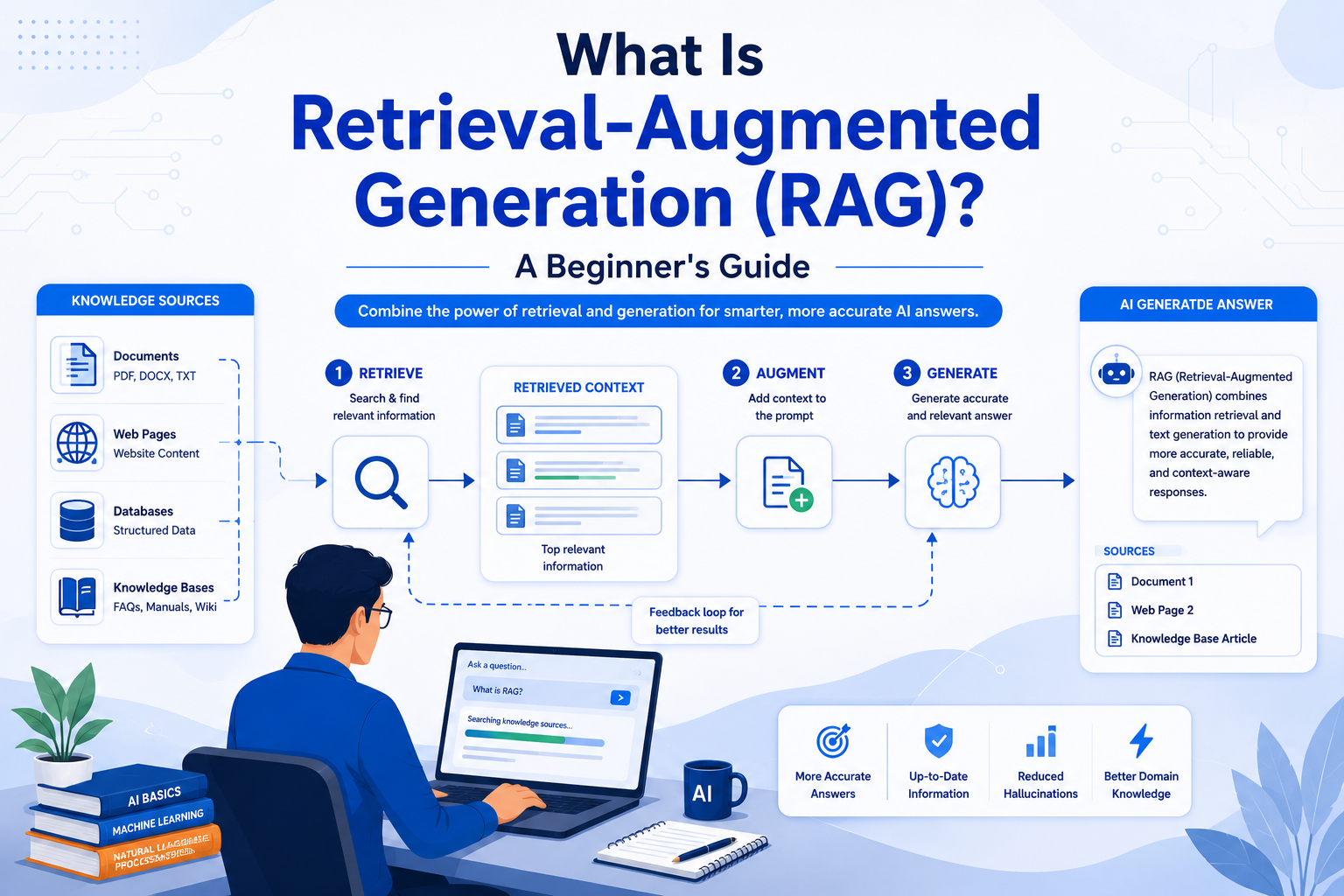
Retrieval-Augmented Generation (RAG) is an AI architecture that enhances a Large Language Model by allowing it to retrieve relevant information from external sources before generating a response.
- Receives a user's query or question
- Searches a knowledge base for relevant information
- Retrieves the most useful and relevant content
- Sends both the query and retrieved context to the language model
- Generates a response grounded in that retrieved information
This approach helps produce responses that are more accurate, up to date, and relevant to the user's question — rather than relying solely on what the model was trained on.
Why Do We Need Retrieval-Augmented Generation?
Large Language Models are powerful, but they have significant limitations that RAG solves:
- Don't know recent events
- Can't access private documents
- Generate hallucinations
- Have static knowledge cutoffs
- Miss domain-specific info
- Retrieves latest information
- Accesses proprietary data
- Grounds responses in facts
- Always current knowledge
- Domain-specific answers
Real Example: Asking an AI assistant about your company's updated HR policy. Without RAG, the system might guess incorrectly. With RAG, it searches the latest policy documents and answers based on current information.
How Does Retrieval-Augmented Generation Work?
A typical RAG workflow consists of several interconnected steps that work together to produce accurate, context-aware responses:
The process begins when a user submits a query or question to the RAG system.
The system receives and processes this query.
The question is transformed into a numerical representation called an embedding.
Embeddings capture the semantic meaning of text, allowing the system to search by meaning rather than exact keywords. This enables more intelligent and contextual retrieval.
The embedding is compared with indexed document embeddings stored in a vector database.
The system retrieves documents that are semantically similar to the user's question, using similarity metrics to identify the closest matches.
The retrieval system ranks the results and selects the most relevant passages or documents.
Only the best matching content is passed to the language model, reducing noise and improving response quality.
The language model receives both the user's question and the retrieved documents.
It generates an answer using both pieces of information, ensuring the response is based on reliable, relevant information rather than assumptions or hallucinations.
Components of a RAG System
A complete RAG architecture consists of several essential components that work together seamlessly:
This is where information is stored. A RAG system can retrieve from multiple types of sources:
- PDFs and Word documents
- Websites and web content
- Databases and structured data
- Internal wikis and documentation
- Product manuals and guides
- Company policies and procedures
Before documents can be searched, they must be processed to extract and prepare the information:
- Extract text from various formats
- Clean and normalize content
- Split into smaller, meaningful chunks
- Remove duplicates and irrelevant data
- Add metadata (titles, dates, authors)
Tip: Smaller chunks improve retrieval accuracy and context relevance.
The embedding model converts text into numerical vectors (embeddings).
These vectors represent the semantic meaning of text, enabling the system to understand and compare meaning rather than just keywords. Popular embedding models include:
- OpenAI's text-embedding models
- Sentence Transformers
- Cohere Embeddings
Embeddings are stored in a specialised vector database designed for fast similarity searches.
Popular vector databases include:
- Pinecone — Fully managed, cloud-based
- Weaviate — Open-source, flexible
- Milvus — Scalable vector database
- Chroma — Lightweight, easy to use
- FAISS — Facebook's research library
The retriever searches the vector database to find the most relevant document chunks based on semantic similarity.
Its primary goal is to return information that best matches the user's query while minimising irrelevant results.
Finally, the retrieved information is passed to an LLM which generates the final response.
The model combines the retrieved context with its reasoning abilities to produce a natural-language answer that is both accurate and helpful.
Key Benefits of Retrieval-Augmented Generation
RAG offers multiple significant advantages over using standalone language models:
- ✓More Accurate Responses — Responses are grounded in factual context rather than relying solely on model memory
- ✓Access to Current Information — Knowledge bases can be updated regularly without retraining the model
- ✓Reduced Hallucinations — Providing supporting documents significantly reduces incorrect or fabricated answers
- ✓Works with Private Data — Organisations can build AI assistants using proprietary documents
- ✓Lower Cost Than Fine-Tuning — Update knowledge bases instead of retraining expensive models
- ✓Easier to Implement — No model retraining required for knowledge updates
RAG vs Fine-Tuning: Which Should You Choose?
Many beginners wonder whether they should use RAG or fine-tuning. The answer depends on your use case:
| Feature | RAG | Fine-Tuning |
|---|---|---|
| Uses latest data | ✓ Yes | ✗ No (unless retrained) |
| Accesses private documents | ✓ Yes | Limited |
| Requires model retraining | ✓ No | ✗ Yes |
| Easy to update | ✓ Very easy | More complex |
| Best for dynamic knowledge | ✓ Yes | ✗ No |
| Best for changing model behaviour | Limited | ✓ Yes |
| Implementation cost | ✓ Lower | Higher |
Common Use Cases for Retrieval-Augmented Generation
RAG is transforming operations across multiple industries by enabling intelligent, knowledge-aware AI systems:
Intelligent Support Chatbots
AI assistants answer customer questions using product manuals, FAQs, and support documentation in real time.
Employee Knowledge Assistants
Employees search company policies, procedures, and documentation using natural language queries.
Intelligent Legal Systems
Law firms retrieve relevant clauses, case law, and legal references from massive document collections instantly.
Medical Decision Support
Practitioners search clinical guidelines, research papers, and treatment protocols for evidence-based answers.
Compliance & Documentation
Banks retrieve policy documents, compliance rules, and customer data to ensure accurate, compliant responses.
Intelligent Learning Assistants
Students ask questions based on textbooks, lecture notes, and research papers with context-aware answers.
Challenges of Building a RAG System
While RAG is powerful, it comes with challenges that developers must address:
- Poor document chunking
- Retrieval accuracy issues
- Outdated knowledge bases
- Context window limits
- Computational costs
- Metadata quality problems
- Smart chunking strategies
- Multiple retrieval passes
- Regular knowledge updates
- Selective context inclusion
- Optimization techniques
- Better indexing methods
Best Practices for Building RAG Applications
Follow these practices to build effective RAG systems that deliver reliable results:
- 1Use High-Quality Documents — Ensure source documents are well-structured and accurate
- 2Choose Appropriate Embedding Models — Select models that fit your domain and language
- 3Implement Smart Document Chunking — Balance context preservation with retrieval accuracy
- 4Include Comprehensive Metadata — Add titles, dates, sources, authors, and categories
- 5Test Retrieval Quality Regularly — Monitor what documents are being retrieved
- 6Monitor User Feedback — Improve indexing and retrieval based on real usage
- 7Keep Knowledge Base Updated — Regular updates ensure information stays current
- 8Evaluate Answer Accuracy — Continuously assess response quality and relevance
The Future of Retrieval-Augmented Generation
RAG technology is rapidly evolving. Expect to see these emerging trends reshape how organisations build AI systems:
Hybrid Search
Combining keyword search and semantic search for more comprehensive retrieval.
Graph RAG
Using knowledge graphs to better understand relationships between information.
Agentic RAG
AI agents planning and executing multiple retrieval steps before responding.
Multimodal RAG
Retrieving from text, images, audio, and video simultaneously.
Personalised RAG
Tailoring responses based on user roles, permissions, and preferences.
Real-Time RAG
Integrating live data streams and APIs for instantaneous information access.
Frequently Asked Questions (FAQs)
What does RAG stand for?
RAG stands for Retrieval-Augmented Generation, an AI technique that combines information retrieval with text generation to produce more accurate and context-aware responses.
How is RAG different from a standard Large Language Model?
A standard LLM relies primarily on its training data. A RAG system first retrieves relevant information from external sources and then uses that context to generate an answer, ensuring responses are based on current, reliable information.
Do I need to fine-tune a model to use RAG?
No. One of the key benefits of RAG is that it can work with external knowledge bases without requiring the language model to be retrained whenever data changes.
What kinds of data can a RAG system use?
RAG systems can retrieve information from PDFs, Word documents, web pages, databases, wikis, spreadsheets, APIs, and other structured or unstructured data sources.
Is RAG suitable for small businesses?
Yes. Small businesses can use RAG to build AI-powered chatbots, searchable knowledge bases, customer support assistants, and internal documentation tools without the cost of frequent model retraining.
How long does it take to implement a RAG system?
Simple RAG implementations can be set up in weeks using pre-built tools and APIs. More complex enterprise systems may take months to design, integrate, and optimise.
Master Retrieval-Augmented Generation
Build production-ready RAG applications and become proficient in modern AI development with hands-on training from industry experts.
RAG Fundamentals
Deep dive into RAG architecture, components, and how they work together
Hands-On Projects
Build real RAG applications using vector databases and LLMs
Industry Applications
Learn real-world use cases from customer support to legal research
Career Advancement
Get certified and prepared for AI engineering roles
Conclusion
Retrieval-Augmented Generation (RAG) bridges the critical gap between the impressive language capabilities of Large Language Models and the need for accurate, up-to-date, domain-specific information. By retrieving relevant content from trusted sources before generating a response, RAG reduces hallucinations, improves factual accuracy, and enables AI systems to work effectively with private or constantly changing knowledge.
For beginners, understanding the core building blocks — embeddings, vector databases, retrieval systems, and generation — is the first step towards building practical AI applications. Whether you're creating a customer support chatbot, an internal knowledge assistant, or a document search tool, RAG provides a scalable and flexible foundation for delivering reliable AI experiences.
As RAG technology continues to evolve with multimodal capabilities, graph-based retrieval, and agentic systems, organisations that master this approach will have a significant competitive advantage in leveraging AI effectively.
Explore More AI Topics
How to Start Learning AI Without Coding
Complete beginner's guide to learning artificial intelligence from scratch without programming experience.
💡 ApplicationsGenerative AI Use Cases Across Industries
Discover practical applications of generative AI transforming businesses and creating new opportunities.
🤖 LLMsLarge Language Models Explained
Understand how LLMs work, their capabilities, limitations, and real-world applications in detail.