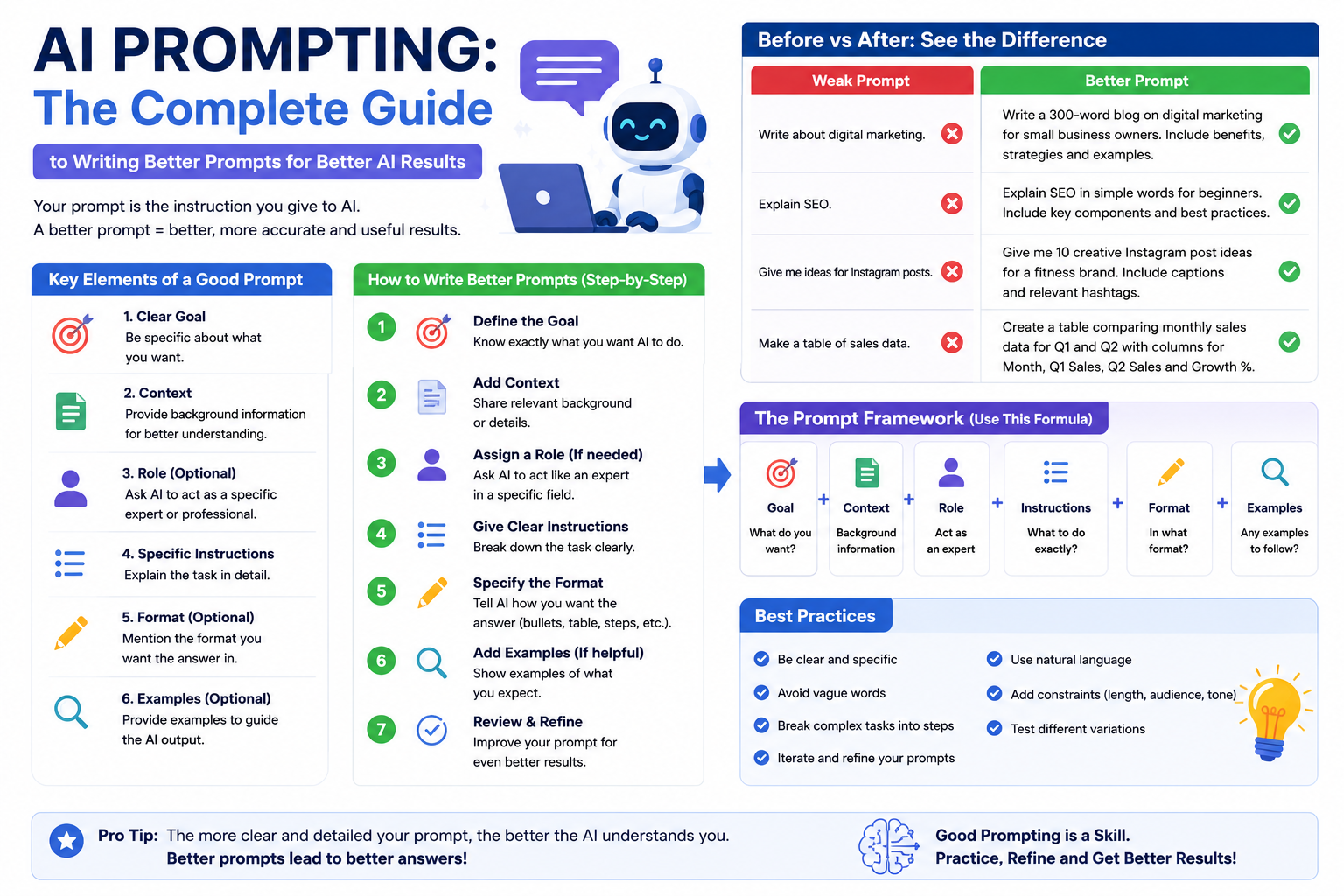
AI Prompting: The Complete Guide to Writing Better Prompts for Better AI Results
Artificial Intelligence has transformed how businesses and individuals work. From writing emails and creating marketing campaigns to generating code, designing presentations, and analyzing data, AI tools like ChatGPT, Claude, Gemini, and Microsoft Copilot are becoming everyday productivity partners.
However, the quality of AI-generated content depends on one critical factor: the prompt. Many people believe AI gives random or inconsistent answers. In reality, the output is only as good as the instructions it receives. This is why AI Prompting has become one of the most valuable digital skills in today's workplace.
What Is AI Prompting?
AI Prompting is the process of giving clear instructions to an artificial intelligence model to achieve a desired outcome. A prompt can be:
- A question
- A command
- A detailed paragraph
- A conversation
- A list of specific instructions
- An uploaded document with requests
Think of AI as a highly skilled assistant. If you simply say:
The AI has very little context. But if you say:
The results become far more useful. The difference is the quality of the prompt.
Why AI Prompting Matters
Good prompting helps AI understand your objective, audience, preferred style, required format, and expected output. Better prompts lead to:
- ✓More Accurate Answers — Clear instructions produce relevant, on-target responses
- ✓Faster Task Completion — Specific prompts require fewer iterations and revisions
- ✓Higher-Quality Content — Better prompts generate more professional, polished outputs
- ✓Reduced Editing Time — Less need to correct or rewrite AI-generated content
- ✓Improved Productivity — Get results right the first time, not after multiple attempts
- ✓Better Decision-Making — AI provides more useful insights with clear prompts
The Basic Structure of an Effective AI Prompt
A strong prompt usually includes these five key elements:
Tell AI who it should act as. Examples: "Act as an SEO expert," "Act as a business consultant," "Act as a software developer."
Clearly define what you want. Example: "Write a blog explaining AI CRM," "Create a marketing strategy outline."
Specify who will read the content. Examples: "for beginners," "for small business owners," "for marketing professionals."
Tell AI how to present the answer. Examples: "as a blog," "as a table," "as a step-by-step guide," "as an FAQ section."
Add specific requirements. Examples: "1,500 words," "SEO optimized," "include examples," "use simple language," "avoid jargon."
Weak Prompts vs Strong Prompts
The difference between a weak prompt and a strong prompt is dramatic. Here's how they compare:
| Aspect | Weak Prompt | Strong Prompt |
|---|---|---|
| Clarity | "Write about AI" | "Write a 1,500-word guide on AI CRM for small businesses" |
| Context | None provided | Audience, use case, industry specified |
| Format | No format specified | Blog post with H2/H3 headings and FAQ section |
| Quality | Generic, broad response | Targeted, specific, actionable content |
| Revisions Needed | Multiple edits required | Minimal revisions needed |
Types of AI Prompts
Informational Prompts
Used to learn something or get information. Example: "Explain machine learning in simple terms for beginners."
Creative Prompts
Used for content creation and ideation. Example: "Write a social media campaign for an AI startup targeting entrepreneurs."
Analytical Prompts
Used for data analysis and insights. Example: "Analyze these sales figures and identify the top three trends."
Coding Prompts
Used by developers to generate code. Example: "Write a Python script that reads CSV files and exports to Excel."
Marketing Prompts
Used for business growth and campaigns. Example: "Generate 20 Facebook ad headlines for an AI CRM platform targeting SMBs."
Image Generation Prompts
Used for AI image tools. Example: "Create a futuristic office with AI assistants, blue lighting, realistic style, 4K resolution."
Common AI Prompting Mistakes
- Being too vague or generic
- Missing important context
- Asking too many things at once
- Ignoring the target audience
- Forgetting to specify output format
- Not providing enough examples
- Be specific and detailed in instructions
- Provide background and context always
- Break complex tasks into smaller prompts
- Always mention the intended audience
- Tell AI exactly what format you need
- Show AI examples of desired output
Advanced AI Prompting Techniques
Chain-of-Thought Prompting
Break complex problems into logical steps. Ask AI to think through a problem step-by-step rather than jumping to a conclusion. This leads to more accurate and thoughtful responses.
Few-Shot Prompting
Provide examples before asking AI to generate new content. Show AI two or three examples of what you want, then ask it to create something similar. AI learns your style and preferences from these examples.
Role Prompting
Assign AI a professional identity like "Marketing Director," "SEO Consultant," "HR Manager," or "Software Engineer." This changes how AI approaches the problem based on that perspective.
Iterative Prompting
Don't expect perfection immediately. Ask AI to improve the answer progressively. Say things like "Make it shorter," "Add more examples," "Rewrite for beginners," or "Improve SEO."
AI Prompting for Business
Businesses use AI prompting to automate and improve:
- Customer support responses and troubleshooting
- Email writing and professional communication
- Proposal and contract creation
- Meeting summaries and action items
- Sales scripts and pitch development
- Product descriptions and specifications
- Social media posts and captions
- Marketing campaigns and strategies
- Business reports and analysis
- Lead qualification and scoring
Instead of spending hours creating content manually, teams can generate high-quality drafts in minutes using well-crafted prompts.
AI Prompting for Digital Marketing
Digital marketers use AI prompting for:
SEO Blog Writing
Create optimized blog posts with keywords and structure.
Keyword Research
Find relevant keywords and analyze search intent.
Meta Descriptions
Create compelling meta tags for SERP listings.
Google Ads Copy
Write high-converting ad headlines and descriptions.
Facebook/Instagram Ads
Create engaging ad copy and audience targeting prompts.
LinkedIn Posts
Generate professional content for thought leadership.
AI Prompting Best Practices
Follow these proven practices for consistently better results:
- ✓Be Specific About Your Goal — Don't assume AI understands what you want
- ✓Provide Enough Context — Background information leads to better results
- ✓Mention Your Target Audience — Content tone changes based on who reads it
- ✓Specify the Desired Format — Outputs vary based on structure requested
- ✓Include Examples If Possible — Few-shot prompting significantly improves output
- ✓Ask for Revisions Instead of Starting Over — Iterative improvement is faster
- ✓Test Different Prompt Variations — Find what works best through experimentation
- ✓Keep Refining Based on Results — Continuous improvement yields better outputs
The Future of AI Prompting
As AI continues to evolve, prompting will become an even more essential workplace skill. In the future:
- Prompting will be integrated into nearly every industry
- Professionals who communicate effectively with AI will advance faster
- Organizations will hire specifically for prompt engineering skills
- AI will become smarter at understanding natural language intent
- Rather than replacing creativity, AI will enhance it through automation
FAQs
What is AI prompting?
AI prompting is the process of giving clear, detailed instructions to an AI model to generate accurate and relevant outputs. The quality of the prompt directly impacts the quality of the response.
Why is AI prompting important?
Better prompts lead to better AI responses, improving accuracy, productivity, and overall output quality. Effective prompting saves time and reduces the need for revisions.
Can beginners learn AI prompting?
Yes. Anyone can learn AI prompting by practicing how to write clear, specific, and structured instructions. It's one of the most accessible AI skills to develop.
What industries benefit from AI prompting?
Marketing, sales, education, healthcare, software development, finance, customer support, manufacturing, and virtually every other industry uses AI prompting to automate tasks and improve efficiency.
Is there a difference between prompting and prompt engineering?
Prompting is simply writing instructions to AI. Prompt engineering is a more technical discipline that optimizes prompts for specific AI models and outcomes.
How do I improve my prompting skills?
Practice regularly with different AI tools, test variations of your prompts, track which approaches work best, and gradually refine your technique through iteration.
Master AI Prompting Techniques
Get actionable prompting templates, real-world examples, and advanced techniques for ChatGPT, Claude, and Gemini.
Prompt Templates
Ready-to-use prompts for business, marketing, content, and more
Real-World Examples
See before-and-after examples of weak vs strong prompts
Advanced Techniques
Learn chain-of-thought, role prompting, and few-shot methods
Industry Best Practices
Tips from professionals using AI daily in their work
Conclusion
AI is only as effective as the instructions it receives. Learning how to write clear, detailed, and goal-oriented prompts is one of the most valuable skills in the age of artificial intelligence.
Whether you're creating content, writing code, analyzing data, or automating business processes, effective AI prompting helps you unlock the full potential of AI tools.
By understanding prompt structure, avoiding common mistakes, and practicing advanced techniques, you can generate more accurate, relevant, and useful AI responses—saving time, increasing productivity, and delivering better results.
Investing time in learning AI prompting today will prepare you for the AI-driven future of work. Start practicing with your next AI interaction and watch your results improve immediately.