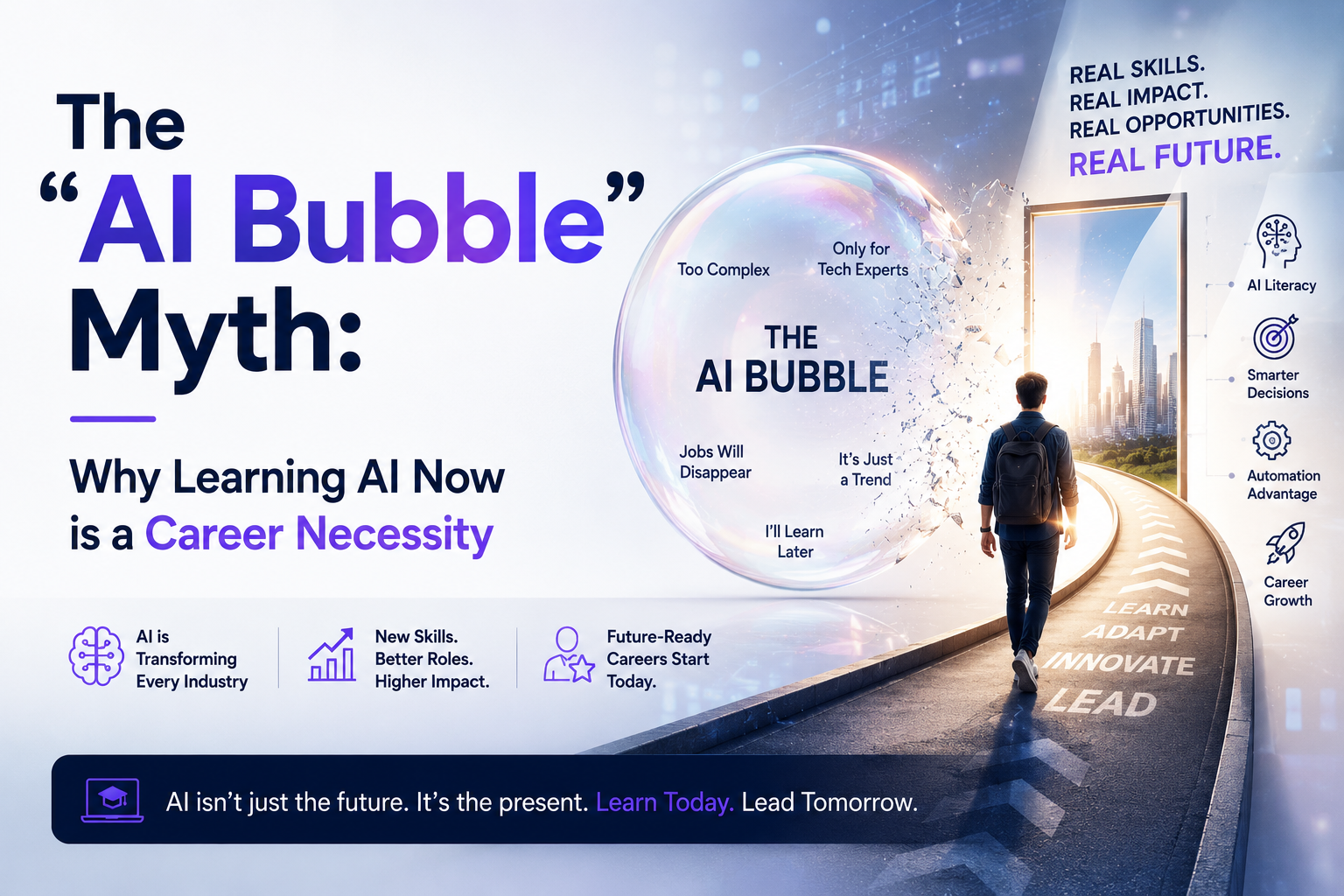
Is AI just a passing trend, or the skill your career actually needs? You've likely heard the "AI bubble" argument—that the current excitement is just hype waiting to burst. But looking at the data, the reality is far more grounded. If you're waiting for the dust to settle, you're already falling behind.
This guide is for professionals, graduates, and mid-career individuals ready to move past the noise and build real, future-proof skills. The case is clearer than you think.
- Why the dot-com bubble comparison misses the mark entirely
- Real data proving AI is embedded in business infrastructure now
- How AI is reshaping expectations across every industry
- The salary premium for AI-literate professionals
- Why waiting is the most expensive mistake you can make
- A practical roadmap to build AI mastery without a computer science degree
- How to make your AI skills visible to employers
The "AI Bubble" Myth: Separating Hype from Reality
When Critics Compare AI to the Dot-Com Bubble, They Miss the Mark
When skeptics invoke the dot-com crash, they're making a fundamental error. The dot-com bubble was fueled by speculation and a lack of revenue models. Companies were valued on hype alone, with no clear path to profitability. It was inevitable that it would collapse.
AI, however, is fundamentally different. It's already deeply embedded in our infrastructure.
Why Skepticism Isn't Strategy
Unlike past tech fads, AI is solving tangible business problems today. It's cutting operational costs, automating workflows, and powering critical tools—from bank fraud detection to healthcare diagnostics. Conflating financial speculation with structural technological shifts is a critical mistake.
The professionals who thrive aren't waiting for consensus. They're building skills while others debate whether the wave is real. By the time skeptics are convinced, the opportunity has moved on.
Why This Time is Different: The Data Doesn't Lie
Business Investment That's Consistent, Not Erratic
According to Microsoft's 2024 Work Trend Index, 75% of knowledge workers are already using AI. This isn't a niche experiment. This is the mainstream. Business investment in AI infrastructure is consistent, not erratic. This technology has crossed the adoption threshold; it's no longer optional—it's the new baseline.
The data tells a story that the skeptics ignore:
- Enterprise adoption is accelerating: Companies are moving beyond pilots to production deployments
- Revenue is flowing: AI companies are profitable and growing, not burning cash on speculation
- Job creation is real: AI-related positions are the fastest-growing category in tech hiring
AI is Reshaping Industries Right Now—Not Later
Real-World AI Impacts Across Every Sector
AI isn't a distant promise. It's the engine running the systems you interact with daily:
Healthcare
Hospitals use AI to predict patient deterioration and scan medical images with higher accuracy than humans—saving lives and reducing diagnostic errors.
Finance
Banks detect suspicious transactions in real-time, while wealth managers use AI for complex forecasting. Risk mitigation has fundamentally changed.
Retail & E-Commerce
From demand forecasting to personalized recommendations, AI optimizes the entire supply chain—cutting waste and boosting revenue simultaneously.
The Shift in Workplace Expectations
Companies Aren't Just Adding Tools—They're Redesigning Roles
Companies aren't just adding tools; they are redesigning roles around AI. Marketing departments now prioritize candidates who can leverage AI content tools, while operations teams seek out talent that can interpret AI-driven data. The baseline has shifted.
If your competitors are using AI to cut costs and speed up delivery, and you aren't, you are losing ground. This isn't about being ahead of the curve anymore. It's about not falling behind.
Your colleague who spent 2024 learning AI is now operating at a different level of productivity and earning power than you. By 2026, that gap has compounded. The question isn't whether to learn AI. The question is how quickly you can catch up.
Why AI Literacy is the New Professional Gold Standard
Job Boards Tell the Story
Job boards today tell a story: AI literacy is no longer a "bonus" qualification—it's an expectation across every sector, from HR to project management. When you see job descriptions that prefer "familiarity with AI tools" or "experience with ChatGPT," that preference will become a requirement within a year.
The Salary Premium for AI Skills
Studies show that workers with demonstrated AI proficiency earn significantly more than their peers. By adding AI competency to your toolkit, you transition from being replaceable to becoming a high-value asset. Employers are eager to pay a premium for professionals who can bridge the gap between traditional workflows and AI-powered solutions.
The Salary Multiplier Effect
Professionals with documented AI skills command 15-30% higher salaries than peers in the same role. Over a 10-year career, that's hundreds of thousands of dollars. Learning AI isn't just career insurance—it's a direct financial investment in yourself.
The Cost of Waiting
Every month you delay is a month where someone else gains a competitive edge. Starting now allows you to shape your career trajectory rather than reacting to market shifts. Whether you want a promotion or a pivot, early adoption compounds in value.
Your Practical Roadmap to AI Mastery
You Don't Need a PhD in Computer Science
You don't need to write code to stay relevant. You need a structured approach to learning. Here's your roadmap:
Step 1: Start Small With Beginner-Friendly Resources
High-quality, accessible resources exist. You don't need to hunt:
Google AI Essentials
Great for job-focused, practical learning. Free and designed for professionals, not academics.
Elements of AI
A non-technical, conceptual overview from the University of Helsinki. Perfect for building understanding without math.
Coursera's AI For Everyone
Ideal for understanding the business impact of AI. Taught by Andrew Ng, a respected voice in the field.
Khan Academy
Excellent for self-paced, foundational knowledge. Build at your own speed without pressure.
Step 2: Identify Your AI Focus
Audit your daily tasks. What is the most repetitive part of your job? That is your starting point. Use AI to solve that specific pain point first:
- Marketers: Explore tools like Jasper or Copy.ai for content generation
- Project Managers: Test Notion AI or Motion for workflow optimization
- Finance Professionals: Look into AI-driven modeling or meeting assistants like Otter.ai
- Analysts: Learn Python basics + ChatGPT for data insights
Step 3: Build Your AI Portfolio
Your skills need to be visible. Here's how:
- Weave AI into your resume: Describe results, not just tools. (e.g., "Reduced reporting time by 40% using AI automation.")
- Volunteer for AI projects: If your company is piloting a tool, be the first to raise your hand
- Get certified: Credentials from recognized institutions validate your expertise to hiring managers
- Create public proof: LinkedIn posts, GitHub projects, or articles showing what you've learned
The Final Word: Your Path Forward
The Uncomfortable Truth About Waiting
The idea that AI is a fleeting trend is a dangerous misconception. It is woven into the fabric of modern business. You don't have to overhaul your life overnight. Small, consistent actions—like dedicating 15 minutes a day to experimenting with AI—will put you ahead of the pack.
The professionals who thrive in the next decade won't necessarily be the ones who knew AI first—they'll be the ones who took it seriously enough to build real, lasting skills. That window is open right now. Step through it.
Don't wait for certainty. Certainty arrives after you've already learned. Start today with one free resource. Spend 30 minutes this week exploring AI tools in your specific field. Build momentum from there. By the time skeptics are convinced, you'll already be three steps ahead.
AI Learning Roadmap 2026
Your personalized 90-day plan to build AI competency. Includes role-specific learning paths, free resource rankings, portfolio building templates, and the exact steps to land AI-powered roles at higher salaries.
Role-Specific Learning Paths
Content creators, analysts, managers—each gets their own track
Free Resource Rankings
Which tools and courses actually deliver results
Portfolio Building Templates
Make your skills visible to employers
Salary Negotiation Guide
How to convert AI skills into higher pay
The Window is Open—Step Through It
The "AI bubble" narrative makes for compelling debate. It's also wrong. The data, the adoption rates, the job market, and the salary premiums all tell the same story: AI is the defining professional skill of this era. Not in five years. Now.
You don't need to believe AI will change everything. You just need to notice that it already has. Your competitors have already noticed. Your employers have already noticed. The question is whether you're going to join them or spend the next year explaining why you didn't.
Start small. Stay consistent. Build visible proof of your skills. The professionals who move decisively today are the ones who shape the future. The ones who wait will be shaped by it. Which are you going to be?