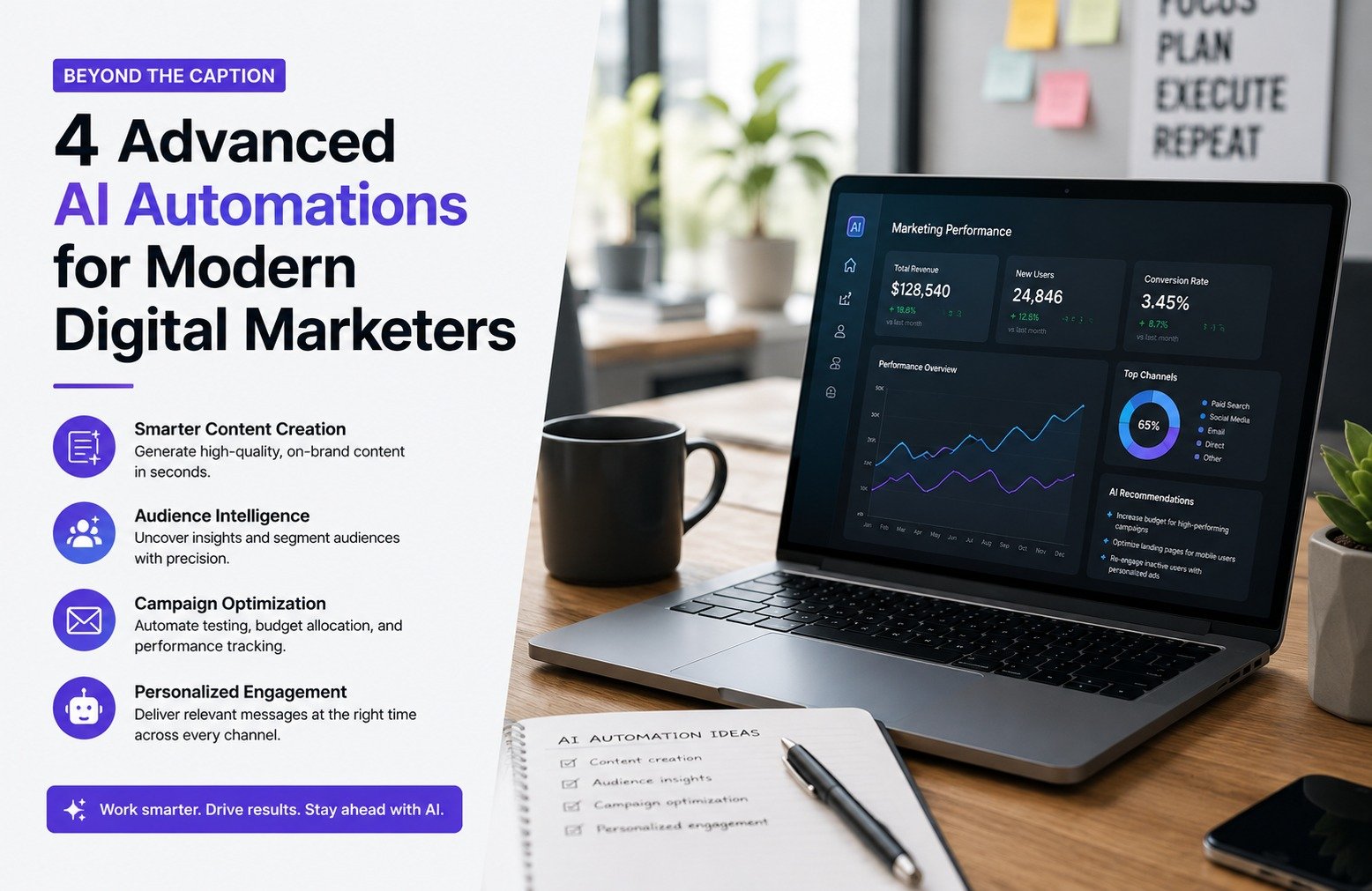
Scheduling posts and writing captions is the easy part. The real competitive edge in digital marketing right now? Knowing how to put AI to work in ways that actually move the needle.
This guide is for digital marketers, social media managers, and marketing teams who are ready to go deeper than the basics. If you're already comfortable with AI tools but want to level up how you use them, you're in the right place.
"The difference between average marketers and exceptional ones isn't the tools they use — it's how they think about automation. One changes tactics. The other changes how work gets done."
Automation 1: Intelligent Content Personalization at Scale
How AI Tailors Messaging to Individual Audience Segments Automatically
AI-driven personalization engines analyze behavioral signals, purchase history, and demographic data in real time to automatically deliver the most relevant message to each user, eliminating manual segmentation guesswork and enabling marketers to engage thousands of unique audience micro-segments simultaneously with precision and consistency.
🎯 What This Actually Means
Instead of creating 20 variations of an email and hoping one resonates, AI identifies what content each individual prospect needs at this exact moment in their journey — and serves it automatically.
Real Results Marketers See From Personalized AI-Driven Campaigns
- Stronger audience engagement — recipients respond more favorably to messaging reflecting their interests
- Higher conversion rates — personalized content converts 2-5x higher than generic broadcasts
- Improved retention — customers feel understood, not manipulated
- Lower unsubscribe rates — relevance reduces email fatigue
- Better lifetime value — personalization compounds over multiple touchpoints
Automation 2: Predictive Audience Targeting & Analytics
Why Predictive Analytics Changes How You Think About Ad Spend
Traditional audience targeting relies on historical data and manual segmentation. Predictive analytics goes a step further — it uses historical patterns to forecast which audiences will convert in the future, allowing you to allocate budget to high-probability segments before you have to guess.
- Analyze past customer data to identify patterns of successful conversions
- Score lookalike audiences based on propensity to convert
- Automatically adjust budget allocation as real-time performance data streams in
- Flag emerging high-value micro-segments before they're obvious to the eye
- Predict churn — tell you which customers are likely to leave so you can retain them
Automation 3: Automated Multi-Channel Campaign Management
Consistency Across Platforms Without Manual Coordination
Managing campaigns across email, social, web, SMS, and push notifications manually is a coordination nightmare. Multi-channel automation orchestrates messaging across all channels simultaneously, ensuring your audience sees a cohesive narrative regardless of where they interact with your brand.
| Channel | Typical Manual Work | Automation Does |
|---|---|---|
| Write copy, format, schedule, follow up manually | Auto-sequences based on behavior, personalizes subject lines, optimizes send time | |
| Social Media | Schedule posts, copy content, update each platform | Auto-publishes to multiple channels, adapts format per platform, monitors engagement |
| Web/Landing Pages | Manual A/B test setup, variant management | Continuous optimization, auto-winner selection, dynamic content switching |
| SMS/Push | Manual timing, segment decisions | Triggered automatically by user behavior, respects quiet hours, prevents fatigue |
How Orchestration Multiplies Campaign Impact
🔗 The Compounding Effect
When channels work in isolation, results are additive. When automated and orchestrated, they become multiplicative. Email awareness → social engagement → landing page visit → conversion. One customer journey across channels, coordinated automatically.
Automation 4: AI-Powered Performance Reporting & Insights
Replacing Manual Reporting With Real-Time AI-Generated Insights
Traditional reporting requires someone to pull data, format it, create visualizations, and write narrative summaries. AI-powered reporting eliminates this entirely. The system continuously monitors campaign data and surfaces real-time insights automatically, freeing you to focus on strategy rather than spreadsheets.
- Identify winning content instantly: AI flags top-performing assets faster than manual analysis
- Spot underperforming channels: Real-time alerts when performance dips below threshold
- Predict tomorrow's outcomes: Forecast campaign results before the day ends
- Generate narrative insights: Automated summaries explain the "why" behind performance
- Recommend next actions: Not just "this underperformed" but "increase spend here instead"
Turning Data Into Actionable Decisions With Automated Dashboards
Automated dashboards consolidate complex data into clear, visual reports that translate raw metrics into actionable recommendations. Marketers no longer interpret numbers manually — instead, AI highlights trends, anomalies, and opportunities, empowering faster, more confident decision-making.
"You stop managing spreadsheets and start managing strategy. The difference in output is dramatic."
Getting Started With Advanced AI Automations
Choosing the Right AI Tools for Your Marketing Stack
Start by auditing your existing platforms and identifying gaps in personalization, analytics, campaign management, and reporting before adding new tools. The best automation stack integrates with what you already use — not replaces it.
- Personalization: Dynamic yield, Optimizely, HubSpot dynamic content
- Predictive Analytics: Segment, mParticle, Amplitude
- Multi-Channel Orchestration: Braze, Iterable, Customer.io
- AI Reporting: Mixpanel, Looker, custom AI dashboards
Implementation Roadmap: Rolling Out One Automation at a Time
Steps to Implement All Four Automations Without Overwhelming Your Team
Roll out one automation at a time, train stakeholders incrementally, and document workflows clearly to maintain momentum without burnout. This phased approach prevents the chaos of trying to change everything at once.
🎯 Month 1: Intelligent Personalization
Start with email content variation. One segment receives personalized subject lines, another receives dynamic body content. Measure lift. Document what worked.
📊 Month 2: Predictive Analytics
Layer in audience scoring. Let AI identify your highest-propensity segments. Run targeted campaigns to just those groups. Track efficiency gains.
🔗 Month 3: Multi-Channel Orchestration
Expand personalized sequences to SMS and social. Create a unified customer journey across channels. Test orchestration impact on conversion.
📈 Month 4: AI Reporting
Set up automated dashboards pulling data from all channels. Let AI surface insights. Shift team focus from reporting to strategy.
Measuring Success and Scaling Your AI-Driven Marketing
Track KPIs Aligned to Each Automation
| Automation | Primary KPI | Success Threshold |
|---|---|---|
| Personalization | Conversion lift vs. control group | 15-30% improvement in CR |
| Predictive Analytics | CAC reduction + ROAS improvement | 25%+ lower CAC, 20%+ higher ROAS |
| Multi-Channel | Cross-channel attribution, LTV | 10-20% increase in customer LTV |
| AI Reporting | Time to insight, decision velocity | 50% reduction in reporting time |
Review performance monthly, and scale only what consistently delivers measurable ROI across channels. Avoid the trap of scaling something that worked once but doesn't sustain.
Master AI Automations for Marketing
Learn the complete 4-automation framework that top digital marketing teams use to scale without burning out. Step-by-step implementation guides + real-world examples.
4 Complete Automation Blueprints
Personalization, predictive analytics, orchestration, and reporting setups you can implement immediately
Tool Integration Guides
How to connect your stack and avoid common setup mistakes
30-Day Implementation Plan
Phased rollout roadmap that scales without overwhelming your team
KPI Tracking Templates
Dashboard templates to measure success and justify investments to leadership
Conclusion: The Future of Digital Marketing Is Intelligent
The landscape of digital marketing has moved far beyond writing clever captions and scheduling posts. Advanced AI automations — from intelligent content personalization and predictive audience targeting to multi-channel campaign management and AI-powered performance reporting — are reshaping what modern marketers can accomplish.
These tools don't just save time; they sharpen decision-making, improve campaign outcomes, and allow marketers to operate with a level of precision that was once out of reach. Marketers who embrace these four automations position themselves ahead of the curve, turning data into strategy and strategy into results.
Whether you're just beginning to explore AI or ready to level up your existing workflows, the next step is simply to start. Pick one automation, test it, learn from it, and build from there. The future of digital marketing is intelligent — and it's already here.