We have all seen the sensationalist headlines splashing across our professional feeds: "AI is coming for your job." "The automation wave will leave millions displaced." It is incredibly easy to get swept up in the panic, or conversely, to shut it out entirely as overhyped corporate tech jargon. But let us strip away the hyperbole and look at the actual reality unfolding across every modern industry today.
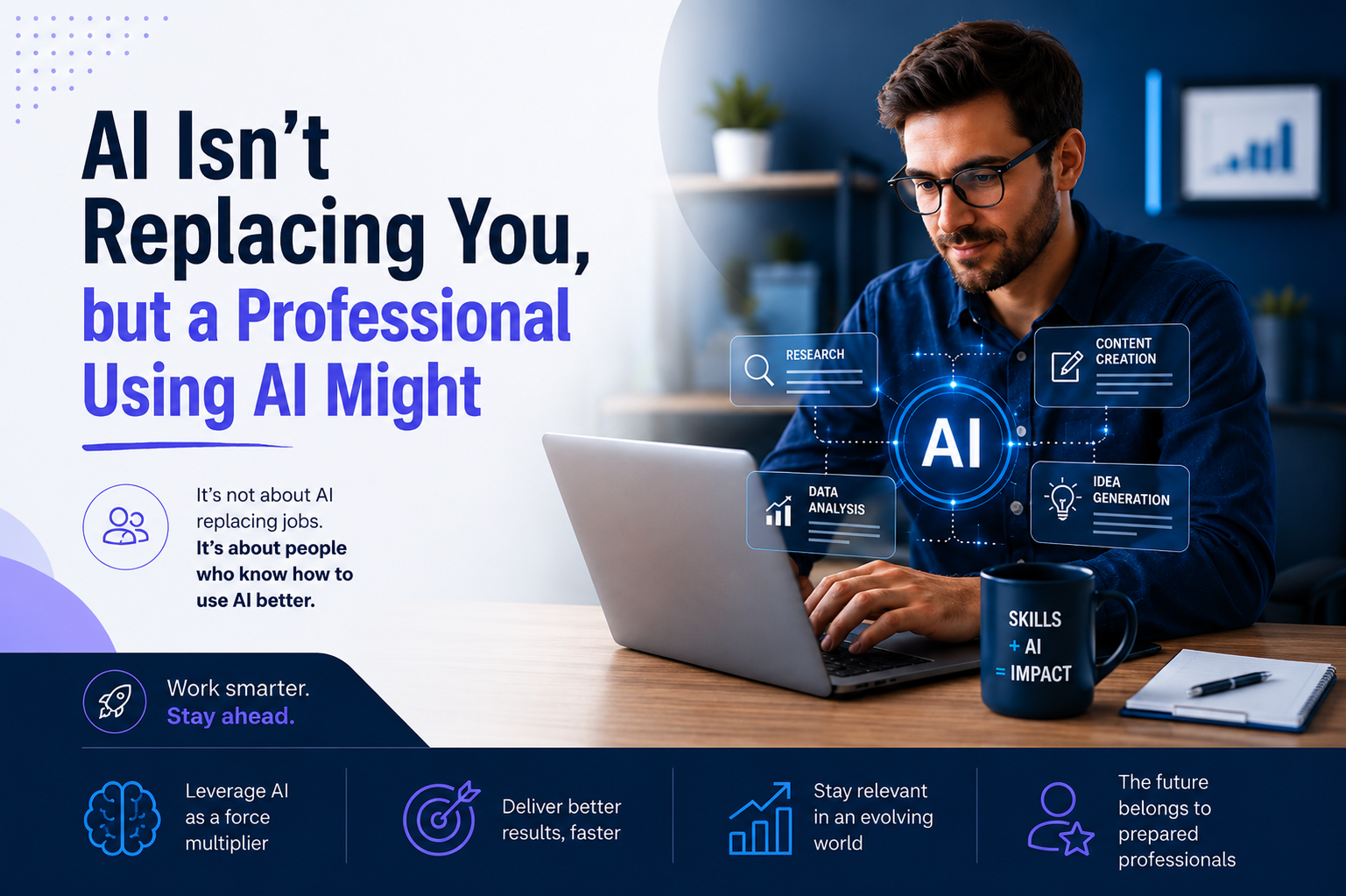
The truth is far more nuanced, practical, and, frankly, liberating. AI isn't replacing you, but a professional using AI might. This isn't just a catchy tagline; it is the fundamental economic reality of the modern workplace. The real competitive threat does not come from a rogue algorithmic script or a disembodied software platform. The threat comes from the colleague down the hall, or the competing business across town, who has quietly figured out how to amplify their daily output tenfold by orchestrating intelligent workflows.
The traditional professional is not being replaced by an algorithm. They are being outpaced by a colleague who learned how to direct AI systems with precision. The stakes have shifted from "can you do the work?" to "can you do it faster and better by leveraging intelligent automation?"
1. The Gate Has Been Broken: The Death of the IT Bottleneck
Historically, adopting next-generation technological infrastructure meant you either needed a massive software engineering budget or deep, specialized technical expertise. If you couldn't write clean code, build databases, or compile intricate scripts, you were forced to wait in line for the IT department to build a tool for you. That era is officially dead.
The democratization of technology has broken down the gates. Today, you can build enterprise-grade automation systems and context-aware digital intelligence workflows with exactly zero coding experience. This is not hyperbole—this is the practical reality that thousands of professionals are already leveraging across finance, marketing, operations, and beyond.
2. The No-Code Shift: Building Advanced Systems Visually
For a long time, software development was confined to a text editor. If you missed a single semicolon or misplaced a bracket, the entire framework collapsed. Today, the landscape has shifted entirely toward visual development environments. Building an advanced workflow or an interactive assistant now looks remarkably like assembling structural building blocks or mapping out an intuitive flowchart.
When we talk about standing out as an AI-powered professional, we aren't talking about writing Python scripts or adjusting deep learning hyperparameters. We are talking about utilizing drag-and-drop interfaces where you visually connect data pipelines, define rules in plain English, and link pre-built modular blocks of intelligence together.
If you possess the logical reasoning to map out a basic business process—knowing that Step A should lead to Step B, and if a customer says X, we should respond with Y—then you already possess the exact prerequisite skills needed to build powerful, automated digital applications. The barrier to entry has collapsed from "you need a CS degree" to "you need clear thinking and logical reasoning."
The most powerful programming language in the world right now is no longer Python, C++, or Java. It is simple, clear, conversational human language.
3. Demystifying the Tech: RAG Assistants and Intelligent AI Agents
To truly understand how to capture this competitive edge with zero coding experience, we need to look under the hood at the two most transformative pillars of modern business automation: Retrieval-Augmented Generation (RAG) and Autonomous AI Agents. These are not theoretical concepts; they are practical tools that are reshaping how work gets done.
4. Context-Aware RAG Assistants
You have likely interacted with standard generative models and realized that while they are highly articulate, they suffer from a major limitation: they do not know anything about your specific business operations, internal manuals, or real-time inventory. They often guess or hallucinate when asked for highly precise information.
This is where Retrieval-Augmented Generation, or RAG, changes the game completely. Think of a RAG assistant as giving an incredibly smart researcher a dedicated, secure library containing your company's exact internal documents, past emails, system user guides, or compliance rules.
- A question is asked to the assistant
- The system sweeps your custom knowledge library for relevant facts
- Verified data is extracted and compiled
- A perfectly tailored, hyper-accurate response is formulated
- No hallucinations, no guessing, only verified information
Imagine building an assistant that instantly answers highly granular queries about complex product features, local regulatory compliances, or specific customer account histories. You can construct these custom knowledge structures completely visually, simply by pointing an interface to a folder of document files or connecting a cloud spreadsheet, without writing a single line of backend database architecture code.
5. Action-Oriented AI Agents: When Systems Execute
While a RAG assistant is masterful at retrieving and presenting information, AI agents take the next massive leap forward: they don't just talk; they execute real-world tasks. An intelligent agent can be assigned a specific business objective, given a set of boundaries, and left to orchestrate multi-step processes on your behalf.
Instead of: Manually copying information from incoming lead forms, analyzing eligibility, writing custom follow-up emails, and scheduling meetings manually...
Your AI Agent: Detects new entries → Scores leads automatically → Cross-references calendar → Drafts personalized responses → Updates your CRM → Sends communication via WhatsApp/email — all automatically, 24/7.
You transition from a manual, administrative task-handler to a high-level system architect, overseeing automated operations that run seamlessly in the background. The monotonous work vanishes; your strategic judgment becomes the differentiator. The agent handles the execution; you handle the direction and optimization.
Ready to Transition to Pilot?
Master no-code AI and build functioning automation systems in just 10 days.
Phase 1: Foundations
Master core AI concepts and workspace automation
Phase 2: Live Building
Deploy RAG assistants and AI agents that work
Hands-On Support
Expert mentors guide you through real projects
6. How to Stay Ahead: Moving From Passenger to Pilot
When paradigm shifts like this occur, professionals generally split into three distinct camps. Understanding which camp you are in—and which camp you want to be in—is the first step toward future-proofing your career.
The Three Professional Camps
| Camp | Behavior | Outcome |
|---|---|---|
| The Avoiders | Ignore the shift, hope the change won't impact their industry | Left behind as industry baselines shift |
| The Superficial Users | Use AI occasionally to clean up emails or summarize articles | Capture ~5% of AI's true capacity |
| The AI-Powered Professionals | Re-architect how they work; learn visual configuration deeply | Become indispensable strategic operators |
Staying ahead in this landscape does not require an advanced technical degree, and it absolutely does not require learning how to write code. It requires an open mind, a structured approach, and a willingness to learn how to direct these visual automation tools effectively.
By mastering the ability to design RAG frameworks and instruct automated workflows, you insulate your career against future displacement. You shift your position from an easily replaceable data processor to an indispensable strategic operator who knows exactly how to leverage technology to drive measurable business outcomes.
7. The Path Forward: No-Code AI Training
The transition to becoming an AI-powered professional doesn't take months of tedious study. It requires focused, practical, hands-on guidance to break through the initial learning curve and build real, functioning automation frameworks immediately.
The 10-Day AI & Automation Workshop is explicitly engineered for professionals with zero coding experience. We take you from absolute baseline concepts to deploying functioning intelligent frameworks through a carefully structured, step-by-step curriculum that emphasizes practical application over theory.
- Phase 1: Foundations of No-Code AI & Workspace Optimization – Master core mechanics of conversational AI interfaces and structural prompting strategies
- Phase 2: Building Live RAG Assistants & Visual Agents – Learn to link proprietary business data securely and design action-oriented agents that execute workflows automatically
- Ongoing: Real-world projects, mentorship, and community support
The Choice Is Yours
AI isn't replacing you. It is not coming for your job. But a professional down the hall who has learned to orchestrate intelligent workflows, configure RAG systems, and direct autonomous agents—that professional might outpace you if you stand still. The barrier to entry has collapsed. The tooling is accessible. The knowledge is available.
The question is no longer "Is AI a threat?" The question is: "Will you learn to direct AI, or will you watch someone else do it?" The competitive advantage in the next five years belongs to those who transitioned from being passengers in the AI revolution to being pilots. The time to learn was yesterday. The second-best time is today.
The future of work is not about competing with AI. It is about leveraging it. Are you ready to make that transition?