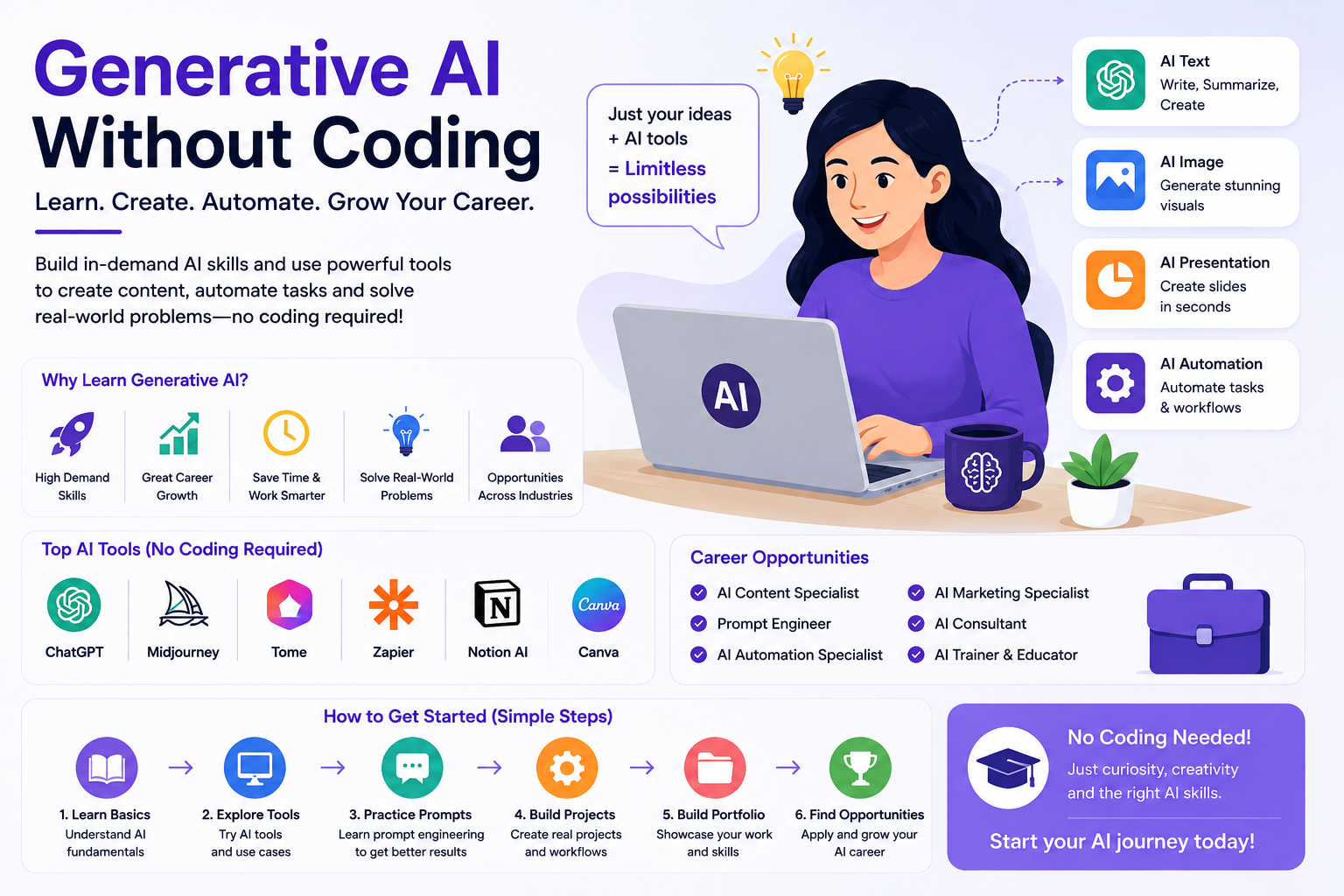
How to Start a Career in Generative AI Without Coding
Generative AI is becoming one of the most exciting technology fields for students, graduates, and working professionals. From creating content and images to automating business tasks and assisting with customer support, generative AI is being used across many industries.
The good news is that you do not always need advanced programming skills to start learning and working with Generative AI. Non-coding learners can build valuable AI skills by understanding AI tools, prompt engineering, workflow automation, content creation, and practical business applications.
This guide explains how beginners can start a career in Generative AI without becoming expert programmers.
What Is Generative AI?
Generative AI is a type of artificial intelligence that can create new content based on user instructions.
- Text
- Images
- Presentations
- Audio
- Videos
- Summaries
- Marketing content
- Business documents
- Ideas and recommendations
- Computer code
Can You Build an AI Career Without Coding?
The simple answer is Yes. While programming knowledge is important for many advanced AI and machine learning roles, there are several AI-related career paths where coding is not the primary requirement.
- Generative AI
- Prompt engineering
- AI content creation
- AI automation
- AI-assisted marketing
- AI-powered customer support
- AI workflow design
- AI tool implementation
- AI project coordination
- AI training and consulting
Who Should Learn This?
Traditional AI development can require programming, mathematics, statistics, and machine learning knowledge. Generative AI tools have changed the entry barrier for beginners — many tasks can now be performed through natural-language instructions and visual interfaces.
Learning Generative AI can help non-technical students:
- Improve productivity
- Create content faster
- Automate repetitive tasks
- Build AI-powered workflows
- Support marketing activities
- Analyze information
- Develop business solutions
- Explore new career opportunities
9 Steps to Build a Career in Generative AI
Before learning advanced tools, beginners should understand the basic concepts behind artificial intelligence: What is AI, Machine Learning, Generative AI, Large Language Models, AI chatbots, prompts, AI agents, and AI automation.
You do not need to become a machine learning engineer to understand these concepts. A basic understanding will help you use AI tools more effectively.
Gain practical experience with commonly used AI tools for text generation, image generation, presentations, and everyday productivity — research, documentation, meeting summaries, emails, and planning.
The goal is not to learn every AI tool available. Instead, become highly comfortable with a few tools that are relevant to your career.
Prompt engineering is the practice of creating clear and effective instructions for AI systems. A good prompt can include the role you want the AI to take, the task, background information, requirements, format, examples, and limitations.
Instead of asking "Write a marketing post," provide a detailed instruction describing the target audience, platform, tone, objective, and format.
AI becomes even more useful when connected to business workflows, for example: Website Form → AI Lead Analysis → CRM → Automated Follow-Up → Sales Team Notification.
A non-coder can learn how these workflows operate using no-code and low-code automation platforms — covering lead qualification, customer support, email automation, content workflows, and appointment scheduling.
Instead of trying to learn everything about AI, choose one area that matches your interests — Content Specialist, Prompt Specialist, Automation Specialist, Marketing Specialist, Business Consultant, or Project Coordinator.
One of the best ways to learn Generative AI is by creating projects — an AI content assistant, a customer support assistant, a lead qualification workflow, a resume assistant, or a study assistant.
A portfolio can be more useful than simply listing AI tools on your resume. Include the project name, problem being solved, AI tools used, workflow, your contribution, and results or expected benefits.
You do not need to start your career from zero. Your existing education or professional skills can become an advantage when combined with AI.
BCom + Generative AI
Explore AI applications in accounting, finance, and reporting
BBA + Generative AI
Focus on AI-powered marketing, sales, CRM, and automation
BCA + Generative AI
Explore AI tools, automation, APIs, and AI-assisted development
BSc + Generative AI
Combine analytical or domain knowledge with AI tools
AI-generated information may sometimes be inaccurate, incomplete, or misleading. Users should verify important information before using it. You should also understand data privacy, copyright considerations, AI bias, fact-checking, and protection of confidential information.
Career Opportunities in Generative AI
As businesses adopt AI tools, several roles and opportunities are emerging around AI implementation and usage.
Generative AI Specialist
Apply Generative AI tools across business functions
Prompt Engineer
Design effective prompts for consistent, high-quality output
AI Content Specialist
Support content creation, research, and marketing campaigns
AI Automation Specialist
Design AI-powered workflows for business tasks
AI Marketing Specialist
Use AI for research, personalization, and campaigns
AI Consultant
Help businesses identify where AI can improve operations
AI Business Analyst
Bridge business needs and AI-driven solutions
AI Project Coordinator
Plan and coordinate AI-related projects
AI Trainer
Teach teams and individuals how to use AI tools effectively
Generative AI Learning Roadmap for Beginners
| Stage | Focus |
|---|---|
| Stage 1 — AI Fundamentals | Understand AI, machine learning, Generative AI, LLMs, and AI applications |
| Stage 2 — AI Tools | Learn text, image, presentation, productivity, and research tools |
| Stage 3 — Prompt Engineering | Learn how to write clear, structured, and effective prompts |
| Stage 4 — AI Automation | Learn how AI can be connected with business workflows and applications |
| Stage 5 — Practical Projects | Build 3–5 small AI projects |
| Stage 6 — Portfolio | Document your projects and create a professional AI portfolio |
| Stage 7 — Career Preparation | Update your resume, LinkedIn profile, and interview skills |
Skills to Learn Along With Generative AI
To become more job-ready, consider developing additional skills that help you use AI as a productivity and problem-solving tool rather than simply relying on AI-generated content.
- ✓Communication & Critical Thinking: Evaluate and present AI-assisted work clearly
- ✓Problem-Solving & Research: Apply AI to real business challenges
- ✓Digital Marketing & Data Analysis: Combine domain knowledge with AI output
- ✓Business Fundamentals & Presentation Skills: Communicate results effectively
- ✓Project Management & Basic Automation: Manage AI-powered workflows end to end
Common Mistakes Beginners Should Avoid
| Mistake | Better Approach |
|---|---|
| Trying to learn every AI tool | Focus on understanding concepts and practical applications, not collecting tools |
| Only watching tutorials | Learning becomes more effective when you build projects and solve real problems |
| Depending completely on AI | AI should support your thinking, not replace it — always review and verify outputs |
| Ignoring your existing skills | Combine your education and professional knowledge with AI for a unique career profile |
| Not building a portfolio | Employers need evidence — practical projects demonstrate your abilities |
Start Your Generative AI Learning Journey
At iSaral Gurukula, learners can develop practical, career-focused technology skills and explore how Generative AI can be applied to real-world tasks.
- ✓Introduction to AI & Generative AI — Build a solid foundation from scratch
- ✓Hands-On Practice — Work with leading AI tools directly
- ✓Prompt Engineering Techniques — Learn to get consistently better AI output
- ✓Real-World Projects — Apply your learning to genuine assignments
- ✓Career Guidance — Portfolio development and job readiness support
- ✓Industry-Relevant Use Cases — Across different professions and sectors
Build Your Generative AI Career, No Coding Needed
Join thousands of students learning Generative AI with hands-on projects, expert mentorship, and career support.
No Coding Required
Learn AI using no-code platforms accessible to everyone
Hands-On Projects
Build real AI applications and create a portfolio
Expert Mentorship
Learn from professionals with real AI experience
Career Support
Job preparation, interviews, and placement assistance
Conclusion
Starting a career in Generative AI does not necessarily mean becoming a programmer or machine learning engineer. Non-technical learners can build valuable AI skills by understanding Generative AI, mastering AI tools, learning prompt engineering, exploring automation, and applying AI to real-world problems.
The most effective approach is to learn, practice, build projects, and create a portfolio.
Whether you are a BCA, BCom, BSc, BBA, or another graduate, combining your existing knowledge with Generative AI can help you explore new career opportunities and become better prepared for an AI-driven workplace.
Frequently Asked Questions
Can I learn Generative AI without knowing programming?
Yes. Many Generative AI tools can be used through natural-language instructions and visual interfaces. However, learning basic technical concepts can be helpful as you progress.
Is Generative AI suitable for commerce students?
Yes. Commerce students can explore applications of AI in finance, accounting, marketing, business analysis, customer service, and operations.
Do I need a computer science degree for an AI career?
No. Some AI roles require strong technical and programming knowledge, but other roles focus more on AI tools, automation, business applications, content, marketing, and implementation.
How long does it take to learn Generative AI?
The time required depends on your starting point and learning goals. Beginners can start with AI fundamentals and practical tools before gradually moving into automation and specialized applications.
What should I learn first?
Start with AI fundamentals, then learn popular Generative AI tools, prompt engineering, practical automation, and project development.
What should go into a Generative AI portfolio for beginners?
Include the project name, the problem being solved, AI tools used, your workflow, your contribution, and the results or expected benefits — screenshots or demonstrations help too.
Explore More Resources
Career Benefits of Learning Generative AI
Discover job opportunities, salary potential, and career growth from learning AI skills.
🚀 BeginnerComplete Beginners Guide to Learning AI
Step-by-step guide to start your AI journey without any coding experience.
📚 AI CourseGenerative AI Course for Students
Generative AI Course for students looking to build a career in AI.