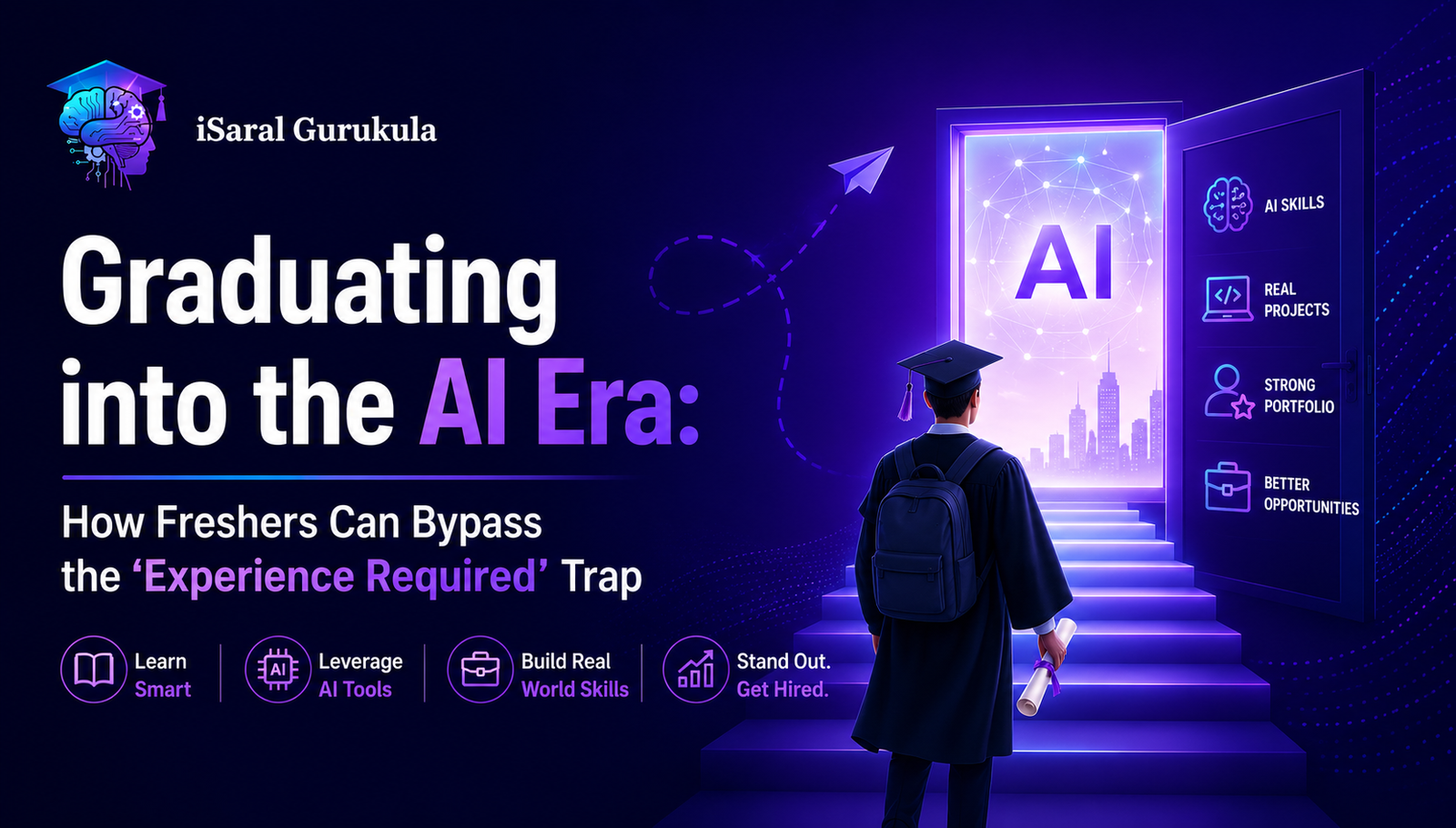
There is a good chance you have spent the last few months staring at job listings that say "Entry Level — 2 to 3 Years Experience Required" and wondering whether someone in HR actually proofreads these things. They do. They just do not care, because for decades that contradiction never needed to be resolved. The queue of desperate applicants was always long enough.
The classic catch-22 has haunted college graduates for generations: you need professional experience to get a job, but you need a job to get professional experience. For most of modern employment history, the only way to break this cycle was to take an unpaid internship, start in a role so junior it barely existed, or apply to hundreds of positions and hope the law of large numbers worked in your favour.
But the rules of the game just changed — and they changed faster than most hiring managers have realised. We are now living in the AI era, a shift in how businesses operate that is completely rewriting what companies actually want from the people they hire. Understanding this shift is the closest thing to a genuine career cheat code that a fresher graduating in 2026 will ever find.
1. Why the Traditional Entry-Level Hiring Process Is Broken
To beat the system, you first have to understand why it is broken. The traditional hiring process relies on outdated proxies for capability. HR departments use years of experience as a filter to weed out resumes because they assume time spent in an office equals competence. It is a lazy heuristic, but in the absence of anything better, it became the standard.
In a fast-moving business landscape, this approach creates a serious problem. Companies are under immense pressure to cut costs and maximise efficiency. They do not want to spend six months walking a new hire through basic market research, data entry, or copywriting. They want immediate output. The traditional model of bringing in a fresher, hand-holding them through eighteen months of learning, and hoping they stay long enough to provide a return on that investment is a structure very few organisations can still afford.
The problem is not your degree, your grades, or your college. The problem is that the traditional signals employers used to evaluate potential — internships at recognisable companies, a certain tier of college name, a list of certifications — have all been commoditised. When every candidate looks the same on paper, any excuse to reject becomes valid. You need a signal that stands apart, and in 2026, that signal is demonstrable AI fluency.
2. How Artificial Intelligence Flattens the Playing Field
This is where the shift becomes genuinely exciting for freshers. AI tools allow a single individual to do the work of a small team in a fraction of the time. The productivity gap between a fresh graduate with strong AI skills and a mid-career professional who refuses to adapt is closing faster than anyone predicted — and in many cases, it is reversing entirely.
Consider a practical example: an experienced professional who has not adopted AI tools might take four hours to draft a comprehensive client proposal. They need to research the company, structure the argument, write the copy, format the document, and review the whole thing. A fresher who understands how to prompt an AI model correctly can generate a highly customised, data-backed proposal template, refine it with two or three iterations, and finalise a professional output in under thirty minutes.
Employers in the AI era are no longer purely paying for hours of accumulated industry knowledge. They are paying for output, speed, and adaptability. A candidate who can walk into a role on day one and deploy AI tools to deliver immediate results is worth more to a modern business than a candidate with two years of experience performing tasks the same slow, manual way.
In the AI era, tech-fluency and adaptability now outrank legacy experience.
3. High-Value AI Skills: Your New Version of Experience
You do not need a computer science degree to thrive in the AI economy. What you need is AI fluency — the ability to leverage existing tools to solve real-world business problems. If you can prove to an employer that you know how to use AI to drive business value, your lack of an official corporate background suddenly stops mattering.
Advanced Prompt Engineering
Prompting is not just about typing casual questions into a chatbot. It is a structured, learnable skill. True prompt engineering involves understanding how to assign specific roles to an AI model, providing precise context, setting constraints, and formatting outputs for professional use. The difference between a novice prompter and a pro is the difference between a tool that produces generic noise and one that delivers a finished deliverable.
AI-Driven Workflow Automation
The most valuable employees in any organisation are those who build systems that run on autopilot. Modern businesses rely heavily on automation. Learning how to connect AI models with everyday business tools via platforms like Zapier or Make allows you to build automated lead-scoring systems, instant customer support routing, or automated content pipelines — all without writing a single line of traditional code.
When you can tell an interviewer: "I built an automated system that captures incoming website leads, scores them using AI, and instantly sends a personalised follow-up via WhatsApp" — they stop looking at your graduation date. They look at your capability. That single sentence is worth more than two years of standard office experience on your resume.
Specialised AI Domain Toolkits
Every industry now has its own specific AI toolkit. Finding the tools that dominate the field you want to enter is part of building your AI fluency stack:
- Marketing: Copy.ai, Jasper, Midjourney, and AI video creation tools
- Sales & CRM: Automated follow-up systems, AI lead scoring and management
- Finance & Data: Advanced Data Analysis features within LLMs to parse large datasets
- Content & SEO: AI-assisted research, keyword mapping, and social distribution pipelines
- HR & Ops: Resume screening assistants, onboarding automation, and workflow mapping
Why Learn With iSaral?
India's most practical AI course — built for freshers and working professionals who want results fast.
No Coding Required
Designed for marketing, sales, finance, HR, and business professionals
Hands-On Projects
Build real AI workflows you can show in interviews from day one
Expert Mentors
Learn from practitioners who use AI tools in real businesses daily
Recognised Certificate
Add a credential that signals AI readiness to every recruiter
4. How to Build a Modern Portfolio That Shuts Down Doubters
If you do not have a traditional resume filled with corporate logos, your portfolio has to do the heavy lifting. The single most important rule is this: show, do not tell. A static list of college projects will not move a hiring manager. You need a live, breathing digital footprint that proves you can take a problem, apply AI tools, and produce a real output.
Create "Ghost Projects" for Real Businesses
Do not wait for someone to hire you to start doing the work. Pick three local businesses or startups you admire. Analyse their current digital presence, identify a gap, and use AI to build a solution for them — without being asked, and without expecting payment. Then package it into a case study.
- Notice a local software agency has slow website response times? Build a custom AI chatbot prototype for their support flow and document the process.
- Is a startup's blog producing thin content? Use AI tools to generate a five-article content strategy with SEO structure, keyword targeting, and social distribution copy.
- Does a small business have zero WhatsApp automation? Build a simple AI-powered lead capture and follow-up workflow using free tools and show the demo.
Even if those companies never hired you to do it, you now have tangible, specific proof of your strategic thinking and technical execution. That is what interviewers remember.
Build in Public on LinkedIn and X
One of the highest-return activities for a fresher in 2026 is documenting your AI learning journey publicly. Share what you are building, which prompts worked, which automation workflows saved you hours, and what you learned from the tools that failed. When recruiters look you up — and they will — they find an active, curious professional who is already contributing to the industry conversation rather than waiting on the sidelines.
5. Pitching Yourself to Employers with Value-First Outreach
Once you have the skills and the portfolio, you need to change how you approach job applications entirely. Sending standard resumes through generic job boards is a numbers game where freshers almost always lose. You need a direct, value-first approach that positions you as a solution-provider before you ever ask for anything in return.
Skip the HR Portal — Go Straight to Decision Makers
Identify the team leads, department heads, or founders at the companies you want to work for. Find them on LinkedIn, verify their details, and reach out directly with a personalised message that focuses entirely on their pain points — not your need for a job. The goal of the first message is not to ask for work. It is to demonstrate that you have already done work relevant to their business.
When you reach out, lead with a specific, relevant piece of value. Not a generic "I'm a recent graduate looking for opportunities." Something like this:
Hi [Name], I've been following your company's growth in the software space. I noticed your team regularly publishes detailed product updates but they're not being distributed across short-form channels. I used an AI content pipeline I built to convert your last three text updates into highly engaging LinkedIn posts and short-form video scripts — I've attached them here for free. If you're looking to scale your content distribution using efficient AI systems, I'd love to chat for 10 minutes.
This approach completely flips the dynamic. You are no longer a fresher asking for an entry-level opportunity. You are a proactive solution-provider who has already shown them how to optimise part of their workflow. That is a conversation most decision-makers will take.
6. Your Competitive Advantage: Old Playbook vs AI-Era Playbook
The experience required trap is only a trap if you continue playing by the old rules. Legacy experience can even become a disadvantage when it comes packaged with rigid habits that resist technological change. Employers in 2026 are actively watching for that inflexibility and filtering it out. Here is how the two approaches compare:
| Old Entry-Level Playbook | AI-Era Playbook |
|---|---|
| Waiting for an open internship posting | Building custom AI solutions independently |
| Listing college courses on a resume | Showing a live portfolio of automated workflows |
| Relying on manual, time-consuming tasks | Leveraging AI to multiply daily output by 5x |
| Applying through generic job portals | Sending high-value, direct pitches to decision makers |
| Hoping years of experience match the JD | Demonstrating AI fluency as the new experience proxy |
| Waiting to be trained on company tools | Arriving with AI workflow skills ready to deploy immediately |
Right now, the gap between freshers who have built genuine AI fluency and those who have not is large enough to be a decisive competitive advantage. In 12 to 18 months, AI skills will be table stakes for most professional roles — not a differentiator. The professionals who build that foundation now, while it still sets them apart, will carry that compounding advantage for the rest of their careers.
Conclusion
The experience required trap is a relic of a hiring system that was designed for a world where output depended almost entirely on time spent doing a task manually. That world is changing faster than the job listings have caught up with. Companies that continue hiring purely on legacy experience signals will be consistently outperformed by those that prioritise AI adaptability — and the freshers who recognise this shift earliest are the ones who will benefit most from it.
You do not need two years in a cubicle. You need demonstrable AI fluency, a portfolio of real outputs, and the confidence to pitch your value directly to the people who can act on it. The tools to build all three are accessible, affordable, and learnable in weeks — not years.
The experience required trap is only a trap if you choose to play by the old rules. The AI era just handed freshers the biggest career advantage in a generation. The question is whether you will use it.